SaaS Website Design Dubai: Convert Visitors to Trial Sign-ups
Dubai's B2B SaaS market is growing rapidly DIFC and Dubai Internet City now host hundreds of software companies competing for GCC enterprise and SME customers. But most SaaS websites in the UAE are direct copies of Silicon Valley playbooks that don't account for how MENA buyers actually make purchasing decisions. Here's what UAE SaaS websites need to do differently.
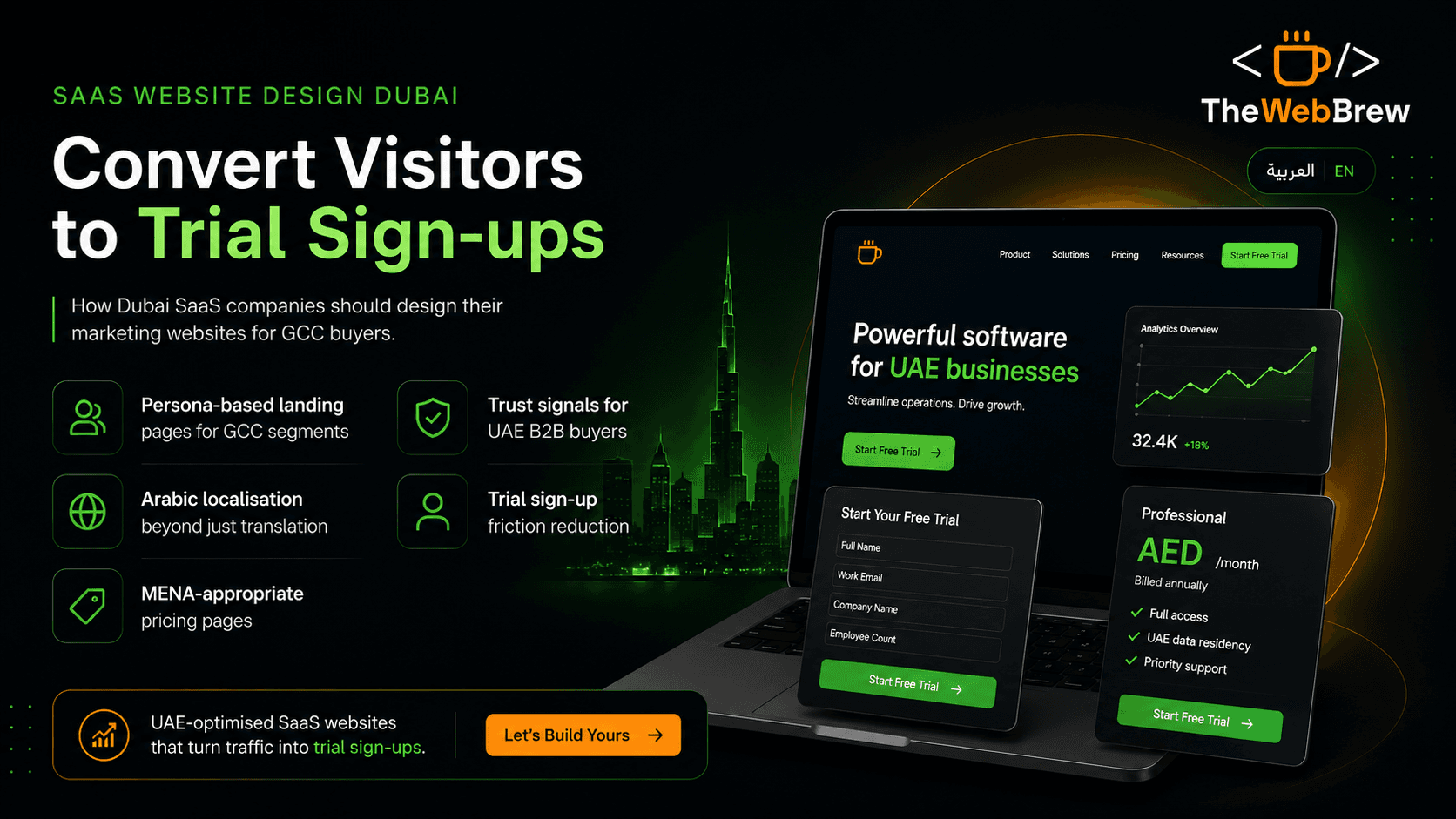
Persona-based landing pages for GCC segments
UAE B2B SaaS sells to a uniquely diverse market SMEs run by Indian, British, Arab, and Chinese founders; enterprise procurement teams at government-linked entities; and family business decision-makers who don't operate like Western corporate buyers. A homepage that tries to speak to all of them speaks to none. Build dedicated landing pages for your two or three clearest customer types, with persona-specific language, use cases, and objection handling.
Arabic localisation beyond just translation
A translated Arabic version of your SaaS website covers the linguistic requirement. True Arabic localisation the thing that actually converts Arabic-speaking users means RTL UI layout that doesn't break your SaaS interface screenshots, UAE-specific use cases in Arabic, and culturally appropriate imagery and references. Arabic SaaS users in the UAE are sophisticated buyers, not a secondary market.
MENA-appropriate pricing pages
SaaS pricing pages designed for Western markets fail in MENA for several reasons: USD pricing feels disconnected (AED pricing converts better), monthly billing is less trusted than annual billing in the region, and 'enterprise pricing contact sales' converts poorly when buyers expect to see numbers. Show AED prices, offer annual-upfront discounts, and provide a clear self-serve trial path that doesn't require a sales call.
Trust signals for UAE B2B buyers
UAE enterprise and government-adjacent buyers demand specific trust signals: local entity registration (UAE company, not just a foreign entity), data residency statements (UAE or GCC-hosted data for government sectors), local support contact details, and references from regionally recognised companies. DIFC-registered SaaS companies can use the DIFC seal as a credibility signal for financial services buyers.
Trial sign-up friction reduction
Every additional field on your trial sign-up form costs conversions. UAE B2B buyers in particular are cautious about providing company information to unknown international SaaS vendors. The optimal UAE SaaS trial form: email, name, company, employee count nothing else. Collect additional data during onboarding when the user has already committed to trying the product.
Frequently asked questions
Should a Dubai SaaS company show pricing in AED or USD on its website?
AED, as the default currency, with the option to toggle to USD for international visitors if you sell beyond the GCC. UAE and wider MENA buyers consistently convert better against local-currency pricing it removes a mental conversion step and signals that you understand and are committed to the regional market rather than treating it as an afterthought to a US-first product. This matters even more for enterprise and government-adjacent buyers, who often need AED figures for internal budget approval processes. If your SaaS product serves multiple GCC markets, consider a lightweight geo-detection that defaults to the visitor's likely local currency (AED for UAE IPs, SAR for Saudi, etc.) while keeping a manual override visible, since IP-based detection is not always accurate for VPN or roaming users.
How much does a persona-based SaaS website with Arabic localisation cost in Dubai?
A B2B SaaS marketing site with 2-3 persona-based landing pages, RTL Arabic localisation, and a MENA-appropriate pricing page typically runs AED 25,000-70,000, depending on the number of personas, whether product screenshots need re-localisation for RTL layouts, and integration complexity with your existing app for trial sign-up flows. Arabic localisation specifically adds 15-25% to a standard build timeline and cost, primarily because RTL layout testing on SaaS product screenshots and UI mockups takes real design time it's not a simple text-flip. Budget separately for ongoing content: persona pages need updating as your ideal customer profile evolves, and MENA pricing benchmarks shift often enough to warrant a quarterly review.
Why do UAE B2B buyers abandon SaaS trial sign-up forms more than other markets?
UAE B2B buyers are notably cautious about handing company information to unfamiliar international vendors, partly due to genuine data governance concerns and partly because government-adjacent and enterprise buyers are simply used to more formal procurement processes. Long sign-up forms asking for job title, company size, phone number, and use case upfront trigger this caution before you've earned any trust. The fix is minimising the form to email, name, company, and employee count nothing else and moving qualifying questions to an onboarding flow after the user has already committed to trying the product. Adding a visible UAE entity registration or data-residency statement near the sign-up form also measurably reduces abandonment for this audience, since it directly addresses the underlying hesitation before it becomes a drop-off.
Related reading
Build your UAE SaaS marketing site
TheWebBrew designs SaaS marketing sites for Dubai and GCC companies persona-based landing pages, Arabic localisation, MENA pricing, and trial conversion optimisation.
Get a Free Quote