Startup Website Dubai: What to Build First & Why It Matters
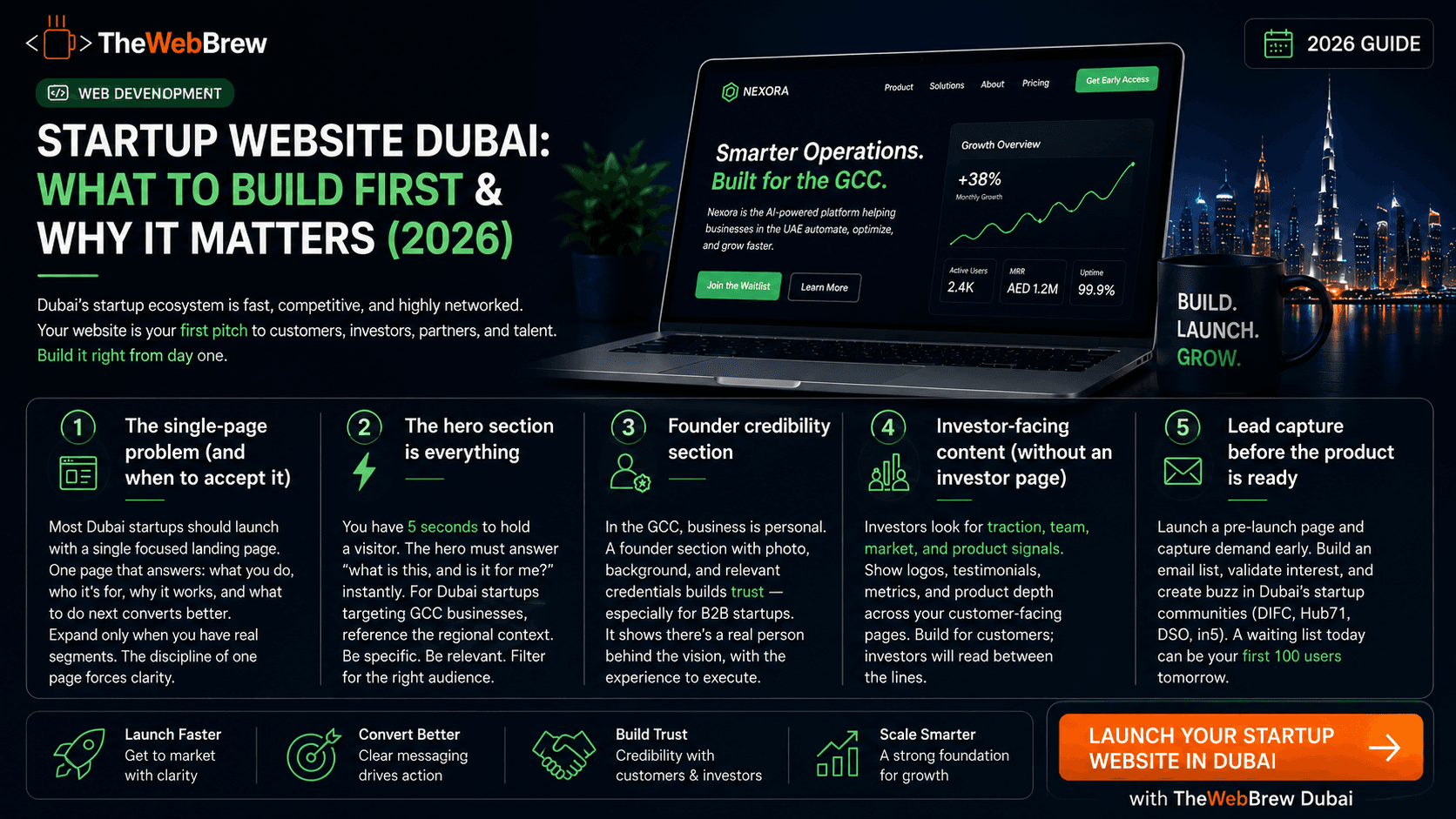
Dubai's startup ecosystem anchored at DIFC, Hub71 Abu Dhabi, Dubai Silicon Oasis, and in5 is competitive, fast-moving, and highly networked. Your website is your first pitch to customers, investors, partners, and employees. Most early-stage Dubai startups underbuild it. Here's what actually matters at each stage.
The single-page problem (and when to accept it)
Most Dubai startups should launch with a single focused landing page, not a multi-page site. One page that answers: what you do, who it's for, why it works, and what to do next converts better than a five-page site that buries those answers. Expand to multi-page only when you have real segments to address differently (investors vs. customers vs. partners, or enterprise vs. SME). The discipline of one page forces clarity about your value proposition.
The hero section is everything
You have 5 seconds to hold a visitor. The hero section the first thing visible without scrolling must answer 'what is this, and is it for me?' instantly. For Dubai startups targeting GCC businesses, the hero must reference the regional context. 'AI-powered inventory management' is generic. 'AI-powered inventory management built for UAE retail and distribution' is specific, relevant, and immediately filters for the right audience.
Founder credibility section
In the GCC, business relationships are personal. For B2B startups especially, a founder section with professional photo, brief background, and relevant credentials (previous company, domain expertise, regional network) significantly improves trust with early enterprise customers. This is less critical for consumer products but essential for B2B SaaS, fintech, and professional services startups.
Investor-facing content (without an investor page)
You don't need a separate 'Investors' page to communicate to investors. Every investor who visits your website looks for: traction signals (logos, testimonials, metrics), team quality, addressable market references, and product sophistication. Engineering these signals into your general customer-facing pages serves both audiences a customer testimonial is also proof of traction. Build for customers; investors will read between the lines.
Lead capture before the product is ready
Many Dubai startups don't launch their website until their product is ready. This is a mistake. A pre-launch waiting list page captures demand signal, builds an email list for launch, and forces you to write down your value proposition clearly. DIFC, Dubai Silicon Oasis, and in5 communities are highly networked a well-circulated pre-launch page in these communities can generate dozens of qualified prospects before you write a line of product code.
Frequently asked questions
Should a pre-launch Dubai startup have a website before the product exists?
Yes a pre-launch waiting list page is one of the highest-leverage moves an early-stage Dubai startup can make, and it doesn't require a finished product. A single page that clearly states what you're building, who it's for, and captures emails via a simple form does three things at once: it validates demand before you commit engineering resources, builds a launch-day email list, and forces you to articulate your value proposition in writing, which is a useful discipline exercise on its own. In DIFC, Dubai Silicon Oasis, and in5 specifically, these communities are tightly networked, so a well-circulated pre-launch page can generate dozens of qualified sign-ups within weeks purely through community sharing, well before you've written a line of product code.
How important is a founder bio section for a UAE B2B startup website?
For B2B startups in the GCC, more important than most founders assume. Business culture across the region places real weight on personal relationships and trust signals before a formal engagement even begins, and a founder section with a professional photo, brief background, and relevant credentials (prior company, domain expertise, regional network) meaningfully speeds up that trust-building process with early enterprise customers. This matters less for consumer products, where the product itself carries the trust signal, but it's close to essential for B2B SaaS, fintech, and professional services startups selling into UAE enterprise or government-adjacent buyers, who often research the founding team before ever picking up the phone.
How many pages should a Dubai startup's first website actually have?
One, in most cases at least at first. A single focused landing page that answers what you do, who it's for, why it works, and what to do next converts better than a five-page site that scatters those answers across separate tabs a visitor may never click through. The discipline of fitting your entire pitch onto one page also forces genuine clarity about your value proposition, which is valuable even beyond the website itself. Only expand to a multi-page structure once you have genuinely distinct audiences to address differently for example, investors, enterprise customers, and individual users each need materially different messaging, at which point separate pages start adding real value instead of just adding navigation.
Related reading
Launch your Dubai startup website
TheWebBrew builds startup websites for Dubai and UAE founders from pre-launch landing pages to full product marketing sites, designed to convert customers and impress investors.
Get a Free Quote