MVP Website Development Dubai: Build Fast, Learn Faster
The MVP website has one job: generate enough signal to know whether your idea is worth building further. Most Dubai startup teams build too much, too slowly, at this stage. Here are the five principles that determine whether your MVP website succeeds at its actual purpose.
Define the single question you are answering
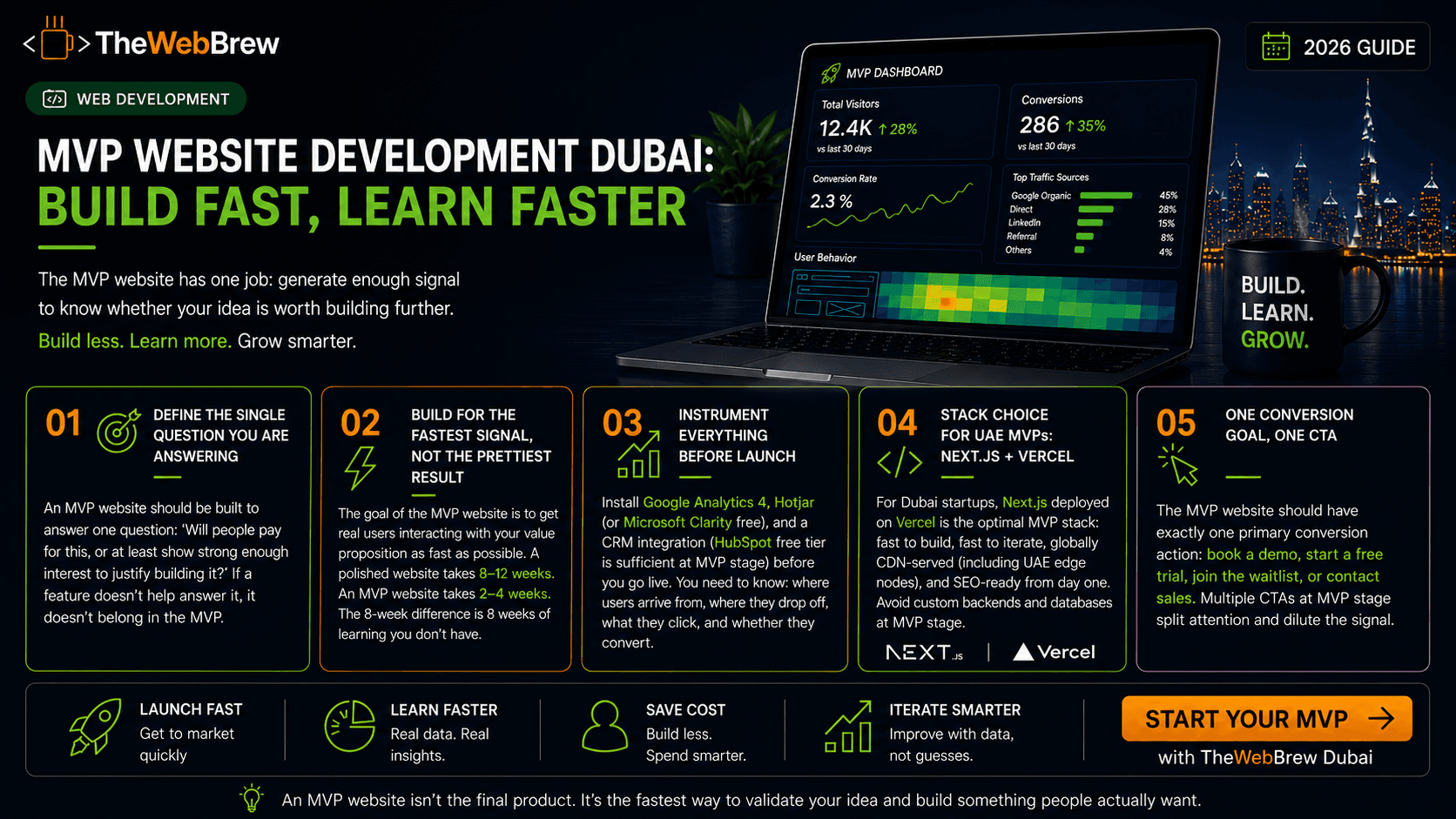
An MVP website should be built to answer one question: 'Will people pay for this, or at least show strong enough interest to justify building it?' Every design decision should be evaluated against that question. If a feature doesn't help answer it, it doesn't belong in the MVP.
Build for the fastest signal, not the prettiest result
The goal of the MVP website is to get real users interacting with your value proposition as fast as possible. A polished website takes 8–12 weeks. An MVP website takes 2–4 weeks. The 8-week difference is 8 weeks of learning you don't have. In Dubai's fast-moving startup market, speed of learning is a competitive advantage.
Instrument everything before launch
Install Google Analytics 4, Hotjar (or Microsoft Clarity free), and a CRM integration (HubSpot free tier is sufficient at MVP stage) before you go live. You need to know: where users arrive from, where they drop off, what they click, and whether they convert. An MVP that isn't measured is a guess, not a learning.
Stack choice for UAE MVPs: Next.js + Vercel
For Dubai startups, Next.js deployed on Vercel is the optimal MVP stack: fast to build, fast to iterate, globally CDN-served (including UAE edge nodes), and SEO-ready from day one. Avoid custom backends and databases at MVP stage use third-party services (Supabase, Firebase, Airtable) until you've validated that you need custom infrastructure.
One conversion goal, one CTA
The MVP website should have exactly one primary conversion action: book a demo, start a free trial, join the waitlist, or contact sales. Multiple CTAs at MVP stage split attention and dilute the signal. You want to know: how many of the people who saw your value proposition took action? That number is meaningless if they had three different things to click.
Frequently asked questions
How long should it actually take to build an MVP website in Dubai?
A properly scoped MVP website should take 2-4 weeks from kickoff to launch, not the 8-12 weeks a polished full-featured site requires. That timeline assumes you've already defined the single question the MVP needs to answer and resisted the temptation to add features 'while you're at it'. Most Dubai startup teams blow past this timeline not because development is slow, but because scope creeps during the build someone requests a blog, then a careers page, then a second CTA. If your MVP is taking longer than a month, that's usually a scope problem, not a technical one. TheWebBrew builds instrumented MVP websites for Dubai startups in around 3 weeks specifically by locking scope before development starts and treating anything non-essential as a fast-follow after launch.
What analytics and tracking should be set up before an MVP website goes live?
At minimum: Google Analytics 4 for traffic and behaviour, a heatmap tool like Microsoft Clarity (free) or Hotjar for scroll and click behaviour, and a CRM integration even the free tier of HubSpot to capture and track every lead that converts. Set up conversion event tracking for your one primary CTA before launch, not after, so you have baseline data from day one rather than a gap in your learning. For UAE startups specifically, also track traffic source split by device UAE mobile usage skews heavily toward iOS and WhatsApp-driven traffic, and your analytics setup should make it easy to see whether your MVP is converting differently across these segments from the very first week.
Should a Dubai startup MVP website use a no-code tool or custom development?
No-code tools (Webflow, Framer) are reasonable for a true pre-product landing page validating pure interest before you've written any product code. Once you have a working product and need the website to reflect real functionality, demo flows, or integrate with your actual backend, a lightweight custom build on Next.js is worth the modest extra cost and time. The reason: no-code MVPs frequently need a full rebuild within 3-6 months once you've validated demand, meaning you pay twice. A properly scoped custom MVP on modern infrastructure can evolve into your permanent site as you scale, rather than becoming throwaway work the moment you've proven the concept.
Related reading
Launch your MVP website in 3 weeks
TheWebBrew builds instrumented, conversion-focused MVP websites for Dubai startups designed to generate signal fast and scale when you need it.
Start Your MVP