Multilingual Website UAE: Arabic, English & Beyond for UAE Businesses (2026)
The UAE's population is one of the most linguistically diverse in the world over 200 nationalities, with Arabic as the official language and English as the business lingua franca, alongside large communities speaking Hindi, Urdu, Tagalog, and Malayalam. A multilingual website is not just an SEO tactic for UAE businesses: it is a fundamental accessibility and relevance decision.
Arabic RTL: what proper implementation actually looks like
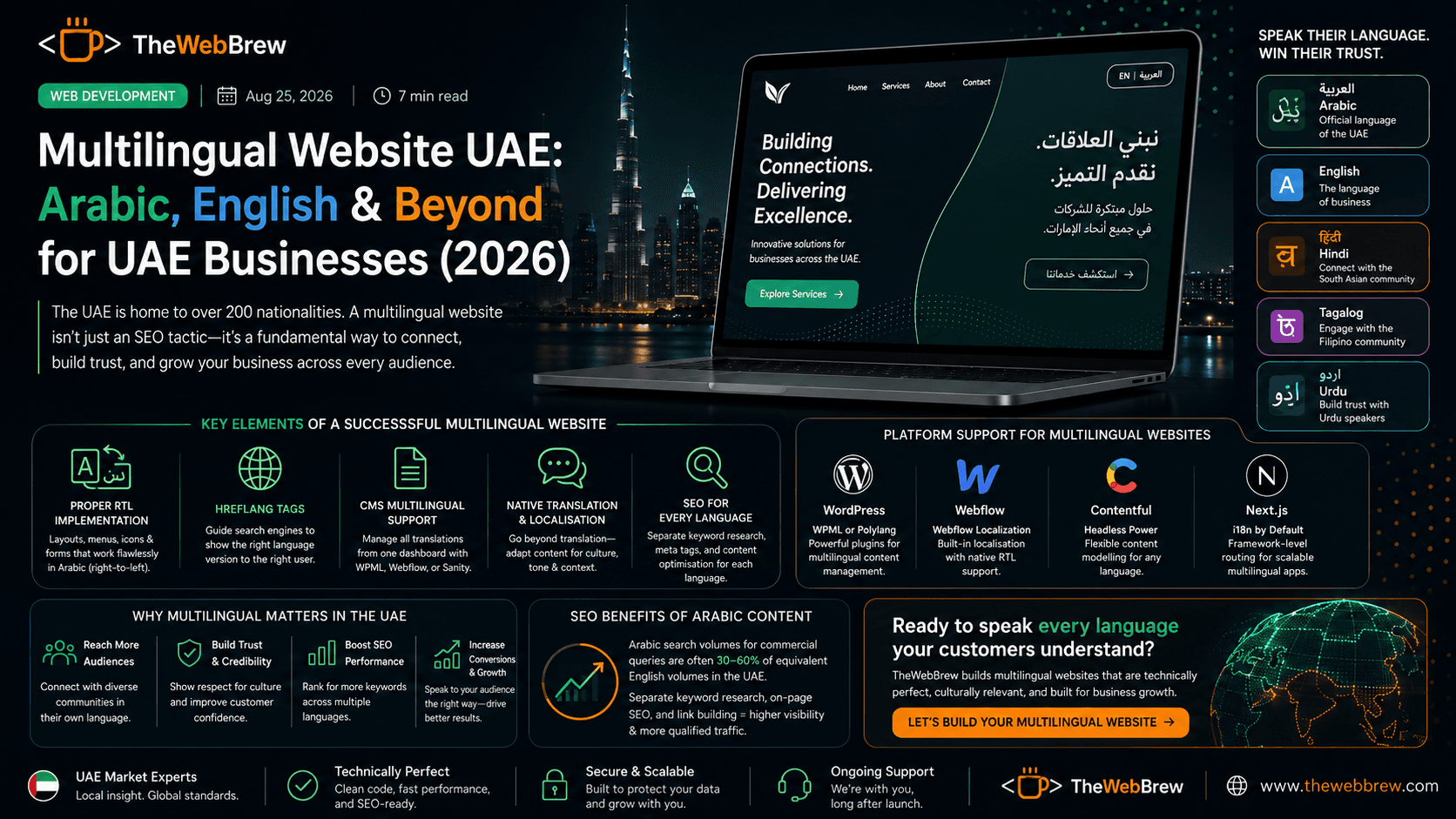
Arabic RTL (right-to-left) implementation is one of the most commonly botched aspects of UAE website development. Simply adding dir=rtl to the HTML and translating text is not sufficient for a professional Arabic experience. Proper RTL implementation means: navigation menus mirror correctly (logo on right, menu items from right to left), icons and directional elements (arrows, progress indicators, sliders) flip direction, form fields have correct text alignment and placeholder direction, layout columns reverse appropriately on Arabic pages, the Arabic typeface is chosen for readability (Noto Kufi Arabic, Tajawal, or Cairo are all well-supported web fonts), and paragraph spacing is adjusted for Arabic script's different visual density compared to English.
hreflang: telling Google which language version to serve
hreflang tags tell Google which language version of your UAE website to show to users based on their language settings. Correct implementation for a UAE Arabic/English site: hreflang x-default (English), hreflang en-ae (English, UAE), and hreflang ar-ae (Arabic, UAE) on every corresponding page pair. Common mistakes: setting hreflang on only the homepage (it must be on every page), missing the self-referential hreflang (each page must reference all its own language variants), using country-only or language-only codes when you should specify both (ar-ae not just ar), and not including hreflang in XML sitemap as well as page headers.
CMS implementation for multilingual UAE websites
How multilingual support is implemented depends on your CMS: WordPress WPML (AED 300–800/year, most mature) or Polylang are the standard options; both create language-specific content versions manageable from a single WordPress admin. Webflow built-in Webflow Localization (launched 2023) supports RTL; pricing is add-on based. Contentful/Sanity (headless) multilingual content modelling is native and flexible, making these the preferred choice for complex UAE multilingual projects. Next.js built-in i18n routing with next-intl or i18next for strings, combined with a multilingual CMS for content. For each approach, the Arabic translation and cultural adaptation should be done by a native UAE Arabic professional, not just any Arabic speaker (Gulf Arabic versus Modern Standard Arabic distinction matters for your audience).
Third languages for UAE businesses
Beyond Arabic and English, UAE businesses should consider which third languages serve their customer base: Hindi and Urdu: combined 25–30% of UAE population; highly relevant for retail, food service, real estate (particularly affordable housing segments), and healthcare targeting South Asian expat communities. Tagalog (Filipino): approximately 700,000 UAE residents; relevant for domestic services, healthcare (nurses and caregivers), retail, and hospitality targeting Filipino expat communities. Malayalam: approximately 800,000 UAE residents (Keralite community); relevant for businesses in the Northern Emirates and trade/logistics sectors. Adding a third language to a UAE website is a significant investment prioritise based on which community represents material business opportunity, not just population size.
SEO benefits of Arabic content for UAE websites
Arabic content on your UAE website captures searches that English content cannot: Arabic keyword volumes for commercial queries are often 30–60% of equivalent English volumes in the UAE. For sectors like real estate, healthcare, education, and government services, Arabic search traffic is proportionally higher. Arabic content requires separate keyword research (Arabic users search differently, using dialect variations and different query structures), separate on-page optimisation (Arabic meta titles, descriptions, H1s), and separate link-building efforts. The SEO value of proper Arabic content not machine-translated content for UAE businesses that serve Arabic-speaking audiences is consistently significant.
Related reading
Build a multilingual UAE website that reaches every audience
TheWebBrew builds bilingual Arabic/English and multilingual websites for UAE businesses proper RTL implementation, hreflang, and content localisation that actually works.
Get a Multilingual Website