Website Redesign Dubai: Rebuild Without Losing Your SEO (2026)
Website redesigns destroy SEO rankings when done carelessly. UAE businesses invest years building organic search visibility, then launch a redesign and watch traffic fall 30–60% in weeks. This is not inevitable with the right pre-launch SEO audit, redirect mapping, and post-launch monitoring, you can redesign your Dubai website and emerge with stronger rankings than you started with.
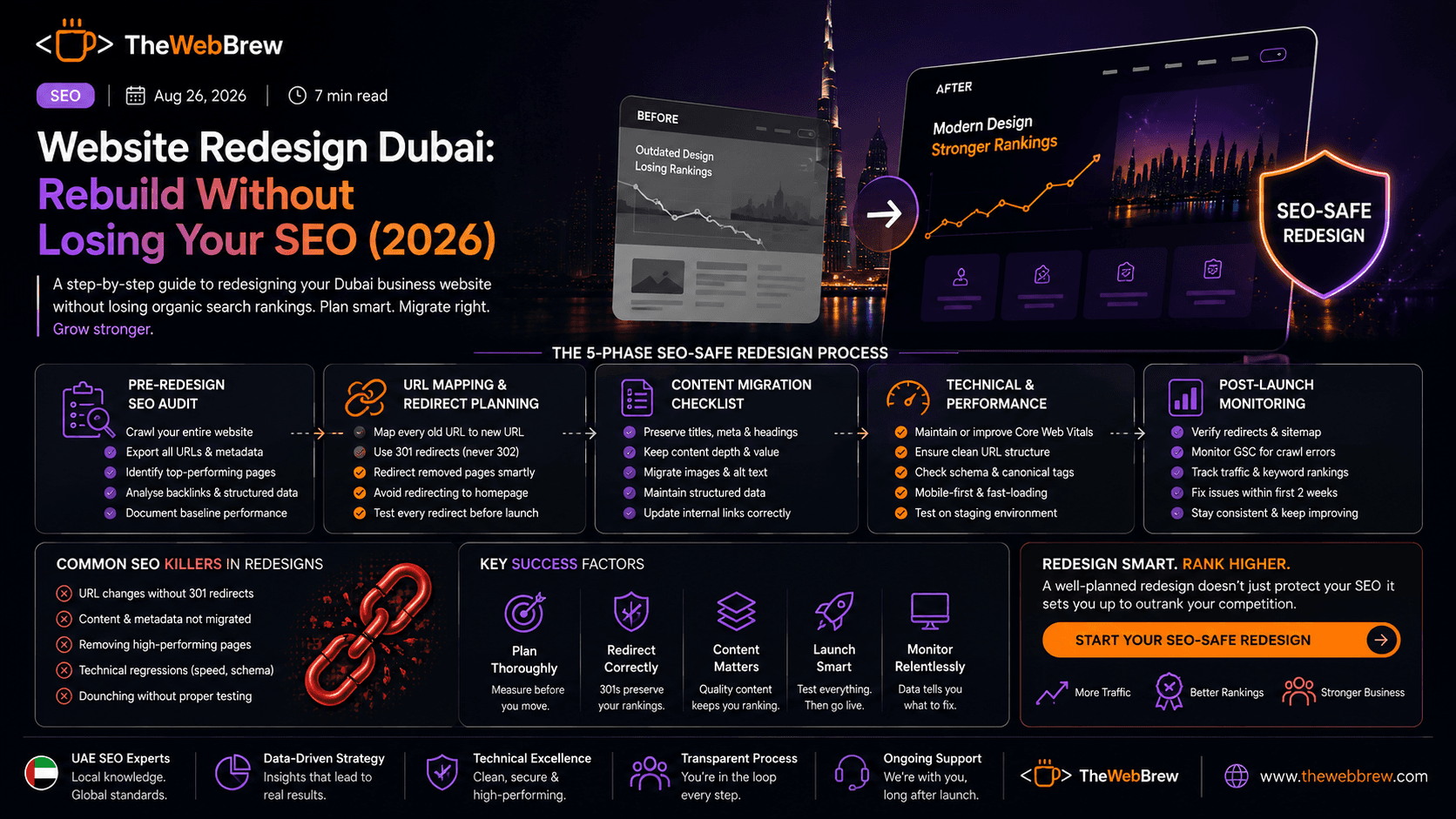
Why website redesigns destroy SEO rankings
The most common SEO killers in UAE website redesigns: (1) URL structure changes without redirects changing /services/web-design to /our-work/web-design without a 301 redirect makes Google think the old page is gone, dropping its rankings. (2) Content migration errors missing or altered title tags, H1s, and meta descriptions that rankings depended on. (3) Removing high-performing pages legacy pages with accumulated backlinks and rankings removed without a redirect plan. (4) Technical regressions the new website has worse Core Web Vitals, broken structured data, or missing canonical tags. (5) Launching without testing a staging environment issue becomes a live disaster.
Phase 1: Pre-redesign SEO audit
Before touching your current website: crawl it with Screaming Frog or Sitebulb to export every URL, status code, title tag, H1, meta description, and canonical. Download your Google Search Console performance data (12 months of organic search clicks, impressions, and position by URL). Identify your top 50 pages by organic traffic these must be handled with exceptional care in the redesign. Identify all inbound backlinks (via Ahrefs or Google Search Console) and note which URLs they link to. Document all structured data (schema markup) on your current site. This pre-redesign audit becomes your migration checklist.
Phase 2: URL mapping and redirect planning
Map every current URL to its corresponding new URL. Rules: if the URL stays the same and content stays similar no redirect needed. If the URL changes create a 301 redirect from old URL to new URL (never 302). If the page is removed with no equivalent redirect to the most topically relevant page (or the homepage as a last resort). Never redirect everything to the homepage (a common shortcut that Google penalises). Build your redirect map in a spreadsheet with columns: old URL, new URL, redirect type, status. Test every redirect before launch.
Phase 3: Content migration checklist
For each page migrated to the new UAE website: preserve the title tag exactly (unless you are intentionally improving it), preserve the meta description (or improve it do not delete it), preserve the H1 and major H2 headings (structural signals Google uses to understand the page), preserve the word count (removing significant content from a ranking page will hurt its rankings), migrate all images with the same alt text, migrate any structured data markup, and check all internal links resolve to the new URL structure. Pages that rank for valuable UAE keywords should be migrated with zero content loss.
Phase 4: Post-launch monitoring
After your UAE website redesign launches: immediately verify all redirects work (use a crawler or the Redirect Checker tool), submit the new XML sitemap to Google Search Console, monitor Google Search Console for crawl errors (the Coverage report) daily for the first two weeks, watch your organic search traffic trend in Google Analytics 4 a temporary dip of 10–20% is normal; a drop of 40%+ signals a problem requiring immediate investigation, and re-check structured data with Google's Rich Results Test. Within 2–4 weeks, Google will have mostly reindexed the new site. If rankings for key UAE terms have dropped significantly after 4 weeks, review the affected pages against the pre-redesign audit checklist.
Related reading
Redesign your Dubai website without losing SEO
TheWebBrew manages SEO-safe website redesigns for Dubai businesses full URL mapping, redirect implementation, content migration, and post-launch search traffic monitoring.
Start Your SEO-Safe Redesign