Government Website UAE: Accessibility, Arabic & WCAG Compliance (2026)
UAE government and public sector digital services are held to standards that go beyond typical commercial websites. The UAE's National Digital Economy strategy and People of Determination policy create specific requirements for government websites around accessibility, Arabic language quality, and digital service design. For UAE government agencies and public sector entities, compliance is not optional and the bar is rising.
UAE digital government standards
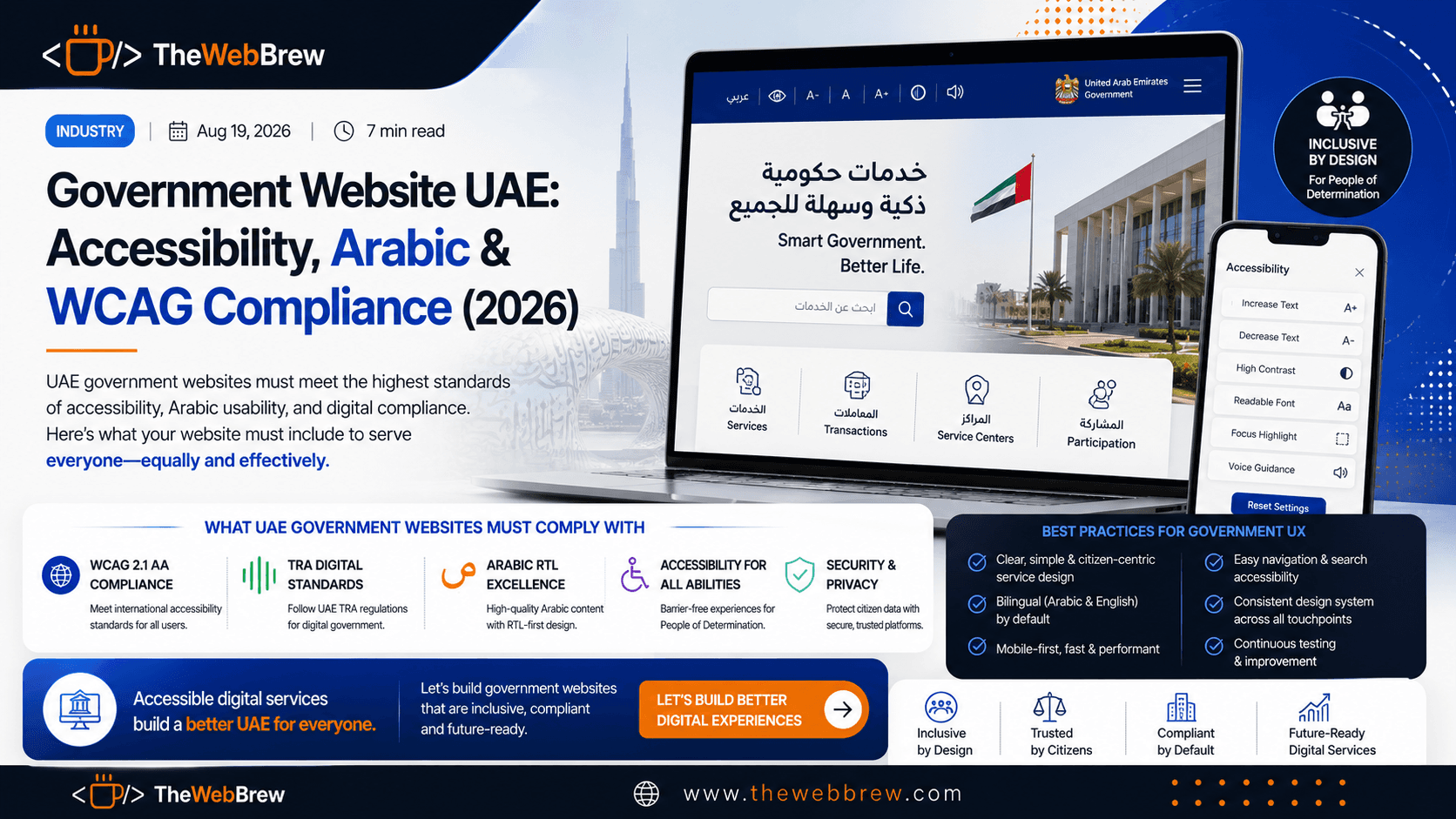
The UAE government has published digital service standards through the TRA (Telecommunications and Digital Government Regulatory Authority) that apply to all federal government websites and are widely adopted by emirate-level agencies. Key requirements include: bilingual Arabic and English with equal quality and depth (not just translated content), mobile-first design (over 80% of UAE government service usage is mobile), WCAG 2.1 AA accessibility compliance, secure HTTPS and UAE data hosting for sensitive services, and performance standards (page load under 3 seconds on standard UAE mobile networks). Dubai Smart Government and the Abu Dhabi Digital Authority (ADDA) publish additional emirate-level standards that apply to DG and Abu Dhabi entity websites respectively.
WCAG 2.1 AA: what it means for UAE government websites
WCAG (Web Content Accessibility Guidelines) 2.1 Level AA is the internationally recognised standard for web accessibility, referenced in UAE government standards and required for any entity that serves People of Determination (the UAE's term for people with disabilities). Key WCAG 2.1 AA requirements: sufficient colour contrast ratios (4.5:1 for normal text, 3:1 for large text), all interactive elements keyboard-navigable, all images have meaningful alternative text, videos have captions and transcripts, forms have clear error identification and instructions, and the website works with screen readers (VoiceOver, NVDA, JAWS). WCAG compliance is testable tools like axe, Lighthouse, and WAVE audit for compliance issues automatically.
Arabic quality and RTL design for UAE government
Arabic language quality on UAE government websites is a matter of national credibility. Common failures: machine-translated Arabic that reads unnaturally or contains errors, LTR-designed layouts that just have Arabic text inserted (misaligned navigation, broken date formats, incorrectly positioned images), Arabic form labels and error messages that do not match the Arabic cultural context, and mixed directionality bugs where English content embedded in Arabic pages breaks RTL flow. Government website Arabic must be reviewed by a native Arabic speaker with formal writing expertise not translated by a bilingual junior staff member or Google Translate. The UAE population includes over 1.4 million UAE Nationals for whom Arabic is the primary language.
Accessibility for People of Determination in the UAE
The UAE Federal Law No. 29 of 2006 on the Rights of People of Determination, and the subsequent National Strategy for Empowerment of People of Determination, place specific requirements on government services. Government websites must be accessible to users with: visual impairments (screen reader compatibility, text resizing support), hearing impairments (captions on all videos, no audio-only content), motor impairments (full keyboard navigation, sufficient click target sizes), and cognitive disabilities (plain language, clear structure, consistent navigation). The UAE's commitment to People of Determination accessibility is reinforced by organisations like the Community Development Authority in Dubai and the Ministry of Community Development federally.
Government UX: designing for the UAE public
Government websites serve every segment of the UAE population from tech-literate young professionals to elderly UAE Nationals accessing services for the first time. Government UX principles for the UAE: use plain language in both Arabic and English (avoid bureaucratic jargon), make the most common service task completable in 3 clicks from the homepage, show progress clearly in multi-step service forms (with save functionality for long forms), provide human support alternatives for every digital service (phone, counter, WhatsApp), and test with real users across demographics. Accessibility testing with actual users who have disabilities almost always reveals issues that automated tools miss.
Related reading
Build a compliant UAE government website
TheWebBrew builds WCAG-compliant, Arabic-first digital services for UAE government entities and public sector organisations accessibility, bilingual design, and TRA standards compliance.
Discuss Your Government Website