React Native vs Flutter vs Native for UAE Apps (2026)
The cross-platform vs native debate has a clear answer for most UAE businesses: build cross-platform unless you have a specific, justified reason not to. But within cross-platform, the React Native vs Flutter choice has real implications for your UAE project developer availability, Arabic RTL quality, and long-term framework risk all factor in.
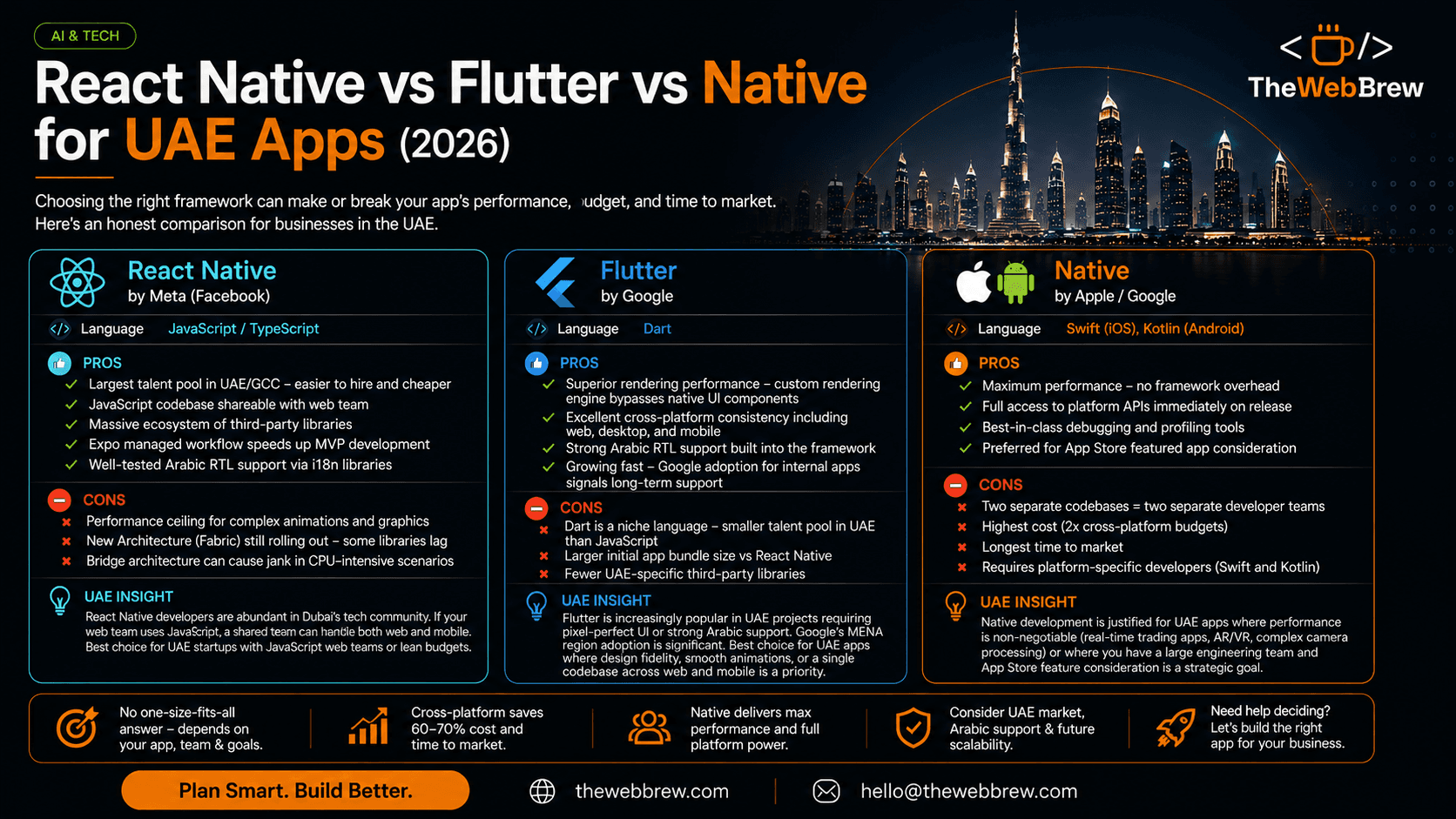
React Native
JavaScript / TypeScriptby Meta (Facebook)
Advantages
- + Largest talent pool in UAE/GCC easier to hire and cheaper
- + JavaScript codebase shareable with web team
- + Massive ecosystem of third-party libraries
- + Expo managed workflow speeds up MVP development significantly
- + Well-tested Arabic RTL support via i18n libraries
Trade-offs
- − Performance ceiling for complex animations and graphics
- − New Architecture (Fabric) still rolling out some libraries lag
- − Bridge architecture can cause jank in CPU-intensive scenarios
UAE context
React Native developers are abundant in Dubai's tech community. If your web team uses JavaScript, a shared team can handle both web and mobile. Best choice for UAE startups with JavaScript web teams or lean budgets.
Flutter
Dartby Google
Advantages
- + Superior rendering performance custom rendering engine bypasses native UI components
- + Excellent cross-platform consistency including web, desktop, and mobile from one codebase
- + Strong Arabic RTL support built into the framework
- + Growing fast Google adoption for internal apps signals long-term support
Trade-offs
- − Dart is a niche language smaller talent pool in UAE than JavaScript
- − Larger initial app bundle size vs React Native
- − Fewer UAE-specific third-party libraries
UAE context
Flutter is increasingly popular in UAE projects requiring pixel-perfect UI or strong Arabic support. Google's MENA region adoption is significant. Best choice for UAE apps where design fidelity, smooth animations, or a single codebase across web and mobile is a priority.
Native (Swift / Kotlin)
Swift (iOS), Kotlin (Android)by Apple / Google
Advantages
- + Maximum performance no framework overhead
- + Full access to platform APIs immediately on release
- + Best-in-class debugging and profiling tools
- + Preferred for App Store featured app consideration
Trade-offs
- − Two separate codebases = two separate developer teams
- − Highest cost (2x cross-platform budgets)
- − Longest time to market
- − Requires platform-specific developers (Swift and Kotlin)
UAE context
Native development is justified for UAE apps where performance is non-negotiable (real-time trading apps, AR/VR, complex camera processing) or where you have a large engineering team and App Store feature consideration is a strategic goal.
Frequently asked questions
Should a UAE startup on a tight budget choose React Native or Flutter?
For most UAE startups on a tight budget, React Native is the more practical starting point, mainly because of talent availability rather than technical superiority. Dubai and Abu Dhabi have a significantly larger pool of JavaScript developers than Dart developers, meaning faster hiring, more competitive freelancer rates, and an easier path to scaling your team later. If your web team already builds in JavaScript or TypeScript, React Native lets you share code and even developers between web and mobile, meaningfully reducing early-stage costs. Flutter becomes the better choice specifically when pixel-perfect UI consistency across platforms or strong built-in Arabic RTL rendering is a hard requirement from day one, since Flutter's custom rendering engine handles this more predictably than React Native's bridge to native UI components. As a rule of thumb: choose React Native for speed and lower hiring costs, choose Flutter when design fidelity and RTL polish are non-negotiable for your UAE launch. Both are dramatically cheaper than native for an MVP.
Does Flutter or React Native handle Arabic RTL layouts better for a UAE app?
Flutter has the edge here Arabic right-to-left support is built directly into its rendering engine, so RTL layouts, text direction, and icon mirroring tend to work correctly with less manual intervention. React Native can absolutely deliver excellent RTL support, but it relies more heavily on third-party i18n libraries and careful manual testing across components, meaning a less experienced team can more easily ship RTL bugs like misaligned icons or incorrect text flow. In practice, the quality gap comes down to the development team's UAE experience more than the framework itself: an experienced Dubai-based React Native team will out-perform an inexperienced Flutter team on RTL every time. If your app is Arabic-first with heavy RTL requirements across complex layouts, Flutter reduces risk. If Arabic is a secondary but still important language alongside English, a competent React Native team with proper i18n libraries and dedicated RTL QA will deliver equally solid results. Always request a live RTL demo before committing to either framework.
When does it make sense to build a native app instead of React Native or Flutter for a UAE business?
Native development (Swift for iOS, Kotlin for Android) is justified for a UAE business in three specific scenarios: real-time trading or fintech apps where every millisecond of performance matters and regulatory scrutiny is high, apps with heavy camera, AR, or complex graphics processing such as property visualisation or retail try-on features, and apps competing for App Store or Play Store featuring where Apple and Google's review teams favour native-built experiences. Outside these cases, native rarely makes financial sense for UAE businesses: you're maintaining two separate codebases, hiring two specialist developer teams, and typically paying twice the budget of a cross-platform build for a similar outcome. For the large majority of UAE apps booking platforms, e-commerce, delivery, real estate listings, service marketplaces cross-platform frameworks deliver most of native's performance at a fraction of the cost and time. Our advice: default to cross-platform unless you can name the specific technical requirement that native uniquely solves for your use case.
Related reading
Build your UAE app in the right framework
TheWebBrew builds in React Native and Flutter we'll recommend the right framework for your UAE use case and build it with full Arabic RTL support.
Get a Free Quote