Progressive Web Apps UAE: When a PWA Beats a Native App
Progressive Web Apps are web applications that deliver app-like experiences installable, offline-capable, push-notification-enabled without App Store distribution. For many UAE businesses, a PWA delivers 80% of a native app's value at 40–60% of the cost. The question is whether your use case falls in that 80% or the 20% that truly requires native.
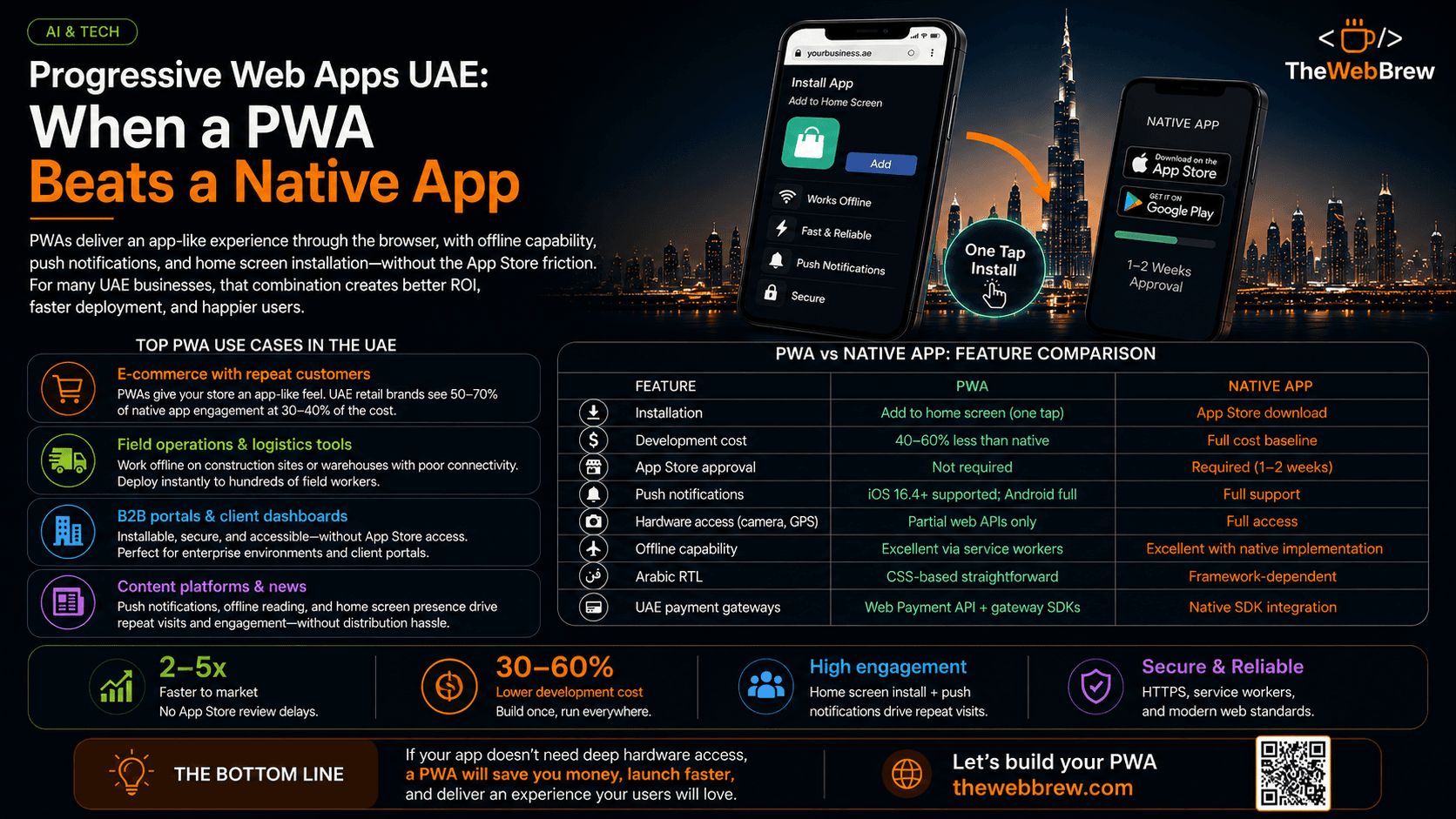
PWA vs native: feature comparison
| Feature | PWA | Native App |
|---|---|---|
| Installation | Add to home screen (one tap) | App Store download |
| Development cost | 40–60% less than native | Full cost baseline |
| App Store approval | Not required | Required (1–2 weeks) |
| Push notifications | iOS 16.4+ supported; Android full | Full support |
| Hardware access (camera, GPS) | Partial web APIs only | Full access |
| Offline capability | Excellent via service workers | Excellent with native implementation |
| Arabic RTL | CSS-based straightforward | Framework-dependent |
| UAE payment gateways | Web Payment API + gateway SDKs | Native SDK integration |
UAE use cases where PWAs deliver strong ROI
E-commerce with repeat customers
PWA lets customers 'install' your store on their home screen without downloading an app. For UAE fashion, grocery, and specialty retail, PWAs with push notifications achieve 50–70% of native app engagement at 30–40% of the development cost.
Field operations and logistics tools
Logistics and field service companies in the UAE need tools that work offline (construction sites, warehouses with poor connectivity). PWAs with service workers can cache data for offline use without App Store distribution headaches critical when you need to deploy a tool to 200 field workers immediately.
B2B portals and client dashboards
B2B client portals that are used regularly but don't need deep hardware access are ideal PWA use cases. The client gets an installable, app-like experience without needing to go to the App Store particularly valuable for enterprise clients with controlled device environments where App Store access may be restricted.
Content platforms and news
UAE media and content platforms with high return traffic are natural PWA candidates. Push notifications, offline reading, and home screen presence replicate the core value of a native news app without the distribution complexity.
Frequently asked questions
Can a PWA replace a native app entirely for a UAE business?
For many UAE businesses, yes for e-commerce with repeat customers, B2B portals, content platforms, and field operations tools, a well-built PWA delivers around 80% of a native app's value at 40–60% of the cost. Where a PWA falls short is deep hardware access: full Bluetooth device integration, background location tracking, or advanced camera and AR features still require native code. If your app's core value proposition depends on one of those capabilities, native is the right call. But if your app is primarily about content, transactions, bookings, or account management, a PWA covers the same ground without App Store approval delays or the ongoing cost of maintaining two separate codebases for iOS and Android. Many UAE businesses start with a PWA to validate demand, then build native later once usage justifies the additional investment.
Do Progressive Web Apps work well with Arabic RTL and UAE payment gateways?
Yes, and in some respects PWAs handle these UAE-specific requirements more simply than native apps. Arabic RTL in a PWA is CSS-based and straightforward to implement and test across screen sizes, whereas native RTL support is framework-dependent and can require separate handling for iOS and Android. For payments, PWAs use the Web Payment API alongside standard gateway SDKs from providers like Telr, PayTabs, or Stripe, which UAE users can complete without leaving the browser or installing anything. The main consideration is push notification support, fully available on Android but only supported on iOS 16.4 and above, so older iPhones may not receive PWA notifications. For the vast majority of UAE users on current devices, this is a minor limitation rather than a dealbreaker.
How much cheaper is a PWA compared to a native iOS and Android app in the UAE?
A PWA typically costs 40–60% less than building separate native iOS and Android apps, primarily because you maintain one codebase instead of two and skip the App Store and Google Play approval process entirely, which usually takes 1–2 weeks per submission and per update. For UAE e-commerce specifically, PWAs with push notifications have been shown to achieve 50–70% of native app engagement at just 30–40% of the development cost, making the ROI case compelling for retailers who don't need deep device integration. The savings compound over time too: ongoing maintenance is simpler with one codebase, and feature updates deploy instantly without waiting for store review. For a UAE business needing to launch and iterate quickly, this cost and speed advantage is often the deciding factor over native.
Related reading
Build a PWA for your UAE business
TheWebBrew builds Progressive Web Apps for UAE businesses offline-capable, Arabic RTL, UAE payment gateways, and push notifications included.
Get a PWA Quote