Next.js vs WordPress for UAE Business Websites (2026)
WordPress powers 43% of the web but Next.js is powering the fastest, highest-converting business websites in 2026. Which one is right for your UAE business depends on what you're actually trying to achieve.
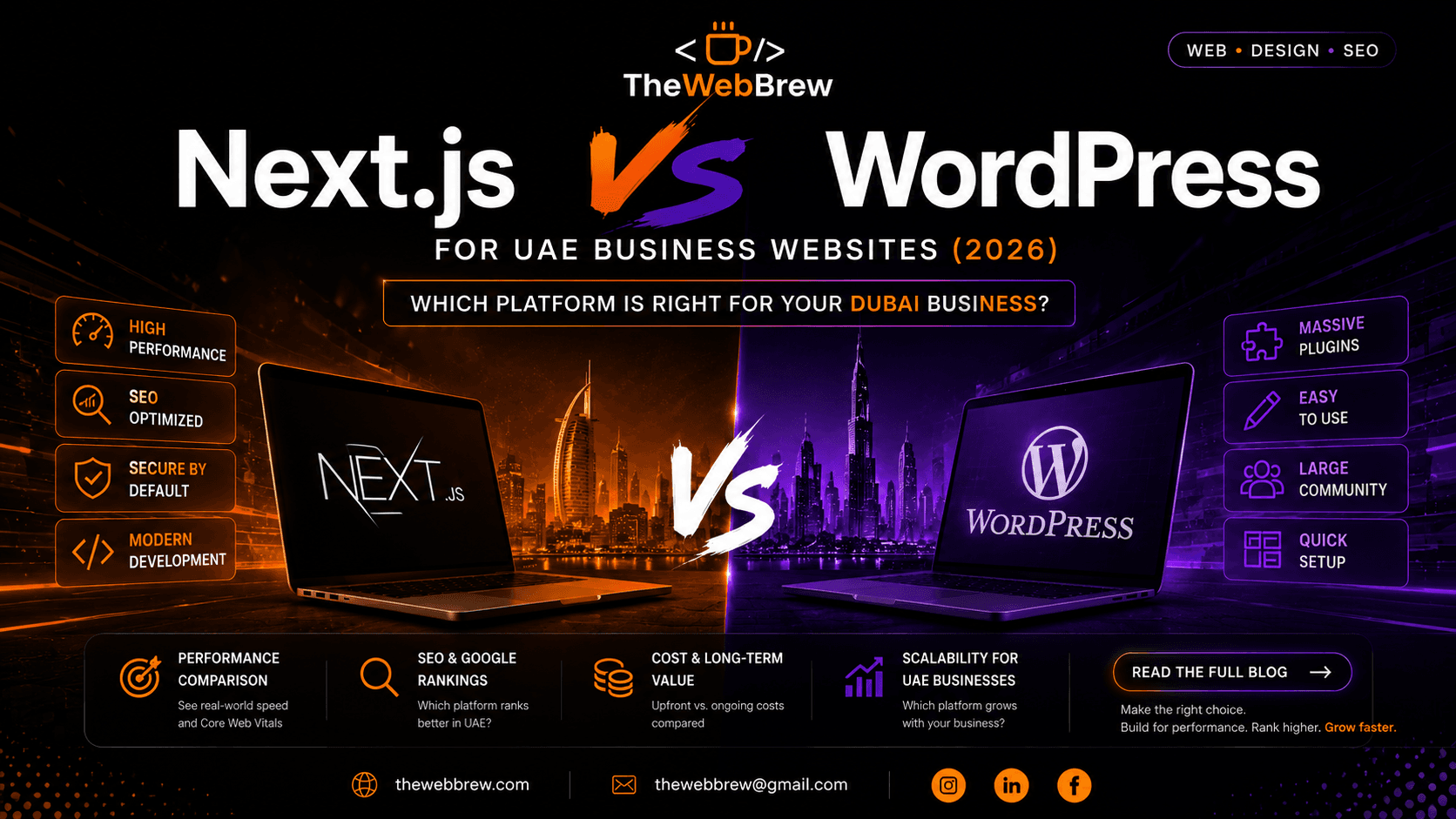
WordPress is familiar, affordable, and has an enormous ecosystem. Next.js is modern, blazing fast, and built for the performance standards that Google cares about in 2026. For UAE businesses investing in a website that will generate leads and rank on Google, this choice has a bigger impact than most people realise.
We build on both. Here's our honest assessment of when to use each.
What they are
WordPress
A content management system launched in 2003. Built on PHP, it powers 43% of all websites. Most UAE agencies build WordPress sites using page builders (Elementor, Divi) on top of premium themes. Easy to manage content, vast plugin library, but carries significant performance and security trade-offs.
Next.js
A React framework launched by Vercel in 2016, now used by Airbnb, TikTok, Nike, and thousands of high-performance businesses. Delivers server-side rendering, static generation, and edge caching out of the box resulting in load speeds that WordPress can rarely match, even with extensive optimisation.
Detailed comparison
Performance
Next.js winsSub-2s loads by default. Static generation and edge caching built in.
Can be fast with heavy optimisation. Defaults to 4–8s without tuning.
Core Web Vitals
Next.js winsLCP, CLS, and INP optimised in the framework itself.
Requires significant plugin + hosting configuration to pass.
SEO ceiling
Next.js winsClean HTML, perfect technical SEO foundation, schema ready.
Yoast/RankMath help but plugin bloat limits performance-based ranking.
Content management
WordPress winsSanity, Contentful, or Notion intuitive editors. Slightly more setup.
Industry standard. Every marketing person knows it. No setup needed.
Plugin ecosystem
WordPress winsBuild custom or use API-based services. No plugin marketplace.
60,000+ plugins for almost anything. Most are free.
Security
Next.js winsNo database exposed to the web. Much smaller attack surface.
43% of all hacked websites run WordPress. Requires constant updates.
Developer cost (UAE)
WordPress winsRequires skilled React/Next.js developers. Less supply in UAE market.
More developers available. Wider price range from freelancers to agencies.
Long-term scalability
Next.js winsBuilt for scale. No performance degradation as content grows.
Gets slower as content and plugins accumulate. Often needs migration at scale.
Which should your UAE business choose?
Choose Next.js if…
- Your website is a primary lead generation asset that needs to rank on Google
- You need the fastest possible load speeds for UAE mobile users
- You're building a platform, SaaS product, or e-commerce store at scale
- Security is important (real estate, finance, healthcare)
- You want a site that performs for 5+ years without needing to rebuild
Choose WordPress if…
- Your team needs to update content daily without developer help
- You need a specific plugin that doesn't have an API equivalent
- Budget is constrained and you accept the performance trade-offs
- You're a blogger, news site, or content-heavy publication
- Your existing site is WordPress and a full rebuild isn't justified yet
Frequently asked questions
Is Next.js better than WordPress for SEO in the UAE?
Next.js has a significant SEO advantage for performance-intensive sites. Server-side rendering and static generation produce faster pages, better Core Web Vitals, and cleaner HTML than most WordPress setups, particularly on mobile, where the majority of UAE search traffic originates. For UAE businesses competing on commercial keywords real estate, e-commerce, professional services this speed advantage compounds over time as Google increasingly weighs page experience signals in ranking decisions. WordPress can achieve comparable performance, but only with significant investment in caching plugins, a premium host, and ongoing optimisation work that Next.js delivers by default. The gap is largest for content-heavy or image-heavy sites, where WordPress's plugin-driven architecture tends to accumulate render-blocking scripts over time. If your website is a primary lead generation channel and ranking on Google is a top priority, Next.js typically outperforms WordPress in both raw speed and long-term ranking potential without ongoing maintenance overhead.
Can non-technical UAE business owners manage a Next.js website?
Yes Next.js is typically paired with a headless CMS such as Sanity, Contentful, or Notion, which gives business owners a simple, intuitive content editor that looks and feels similar to editing a Google Doc. You don't need to touch code to update text, swap images, publish blog posts, or adjust pricing tables the technical complexity lives on the developer's side of the architecture, not the admin side you interact with daily. The main adjustment for UAE teams coming from WordPress is that the editing interface is a separate tool from the live website rather than the same dashboard, which takes a short onboarding session to get comfortable with. Once set up, most business owners find the headless CMS experience faster and cleaner than WordPress's admin panel, since there's no plugin clutter, update notifications, or security warnings competing for attention while you're just trying to publish a blog post.
How much more does Next.js cost vs WordPress for a UAE business?
Next.js development typically costs 30-50% more upfront than an equivalent WordPress site in the UAE market, primarily because it requires more skilled React/Next.js developers, who are in shorter supply locally than WordPress developers and command higher day rates. A typical WordPress business site might cost AED 3,000-25,000, while a comparable Next.js build runs AED 10,000-50,000+ depending on complexity. However, ongoing costs tell a different story: Next.js sites have no plugin subscription fees, a dramatically smaller attack surface (no exposed database means far fewer security vulnerabilities to patch), and no performance-degrading plugin updates to manage over time. Over a 3-5 year horizon, many UAE businesses find the total cost of ownership converges or even favours Next.js, once WordPress's accumulating maintenance, security, and eventual re-optimisation costs are factored in.
Related reading
Not sure which platform is right for you?
We build on both Next.js and WordPress. Tell us your goals and we'll recommend the right technology with a fixed-price quote before any work begins.