Custom Website vs Template: Which Is Right for UAE Businesses?
This is one of the most consequential decisions a UAE business owner makes and most get it wrong because they're comparing upfront costs instead of total value. Here's the honest answer.
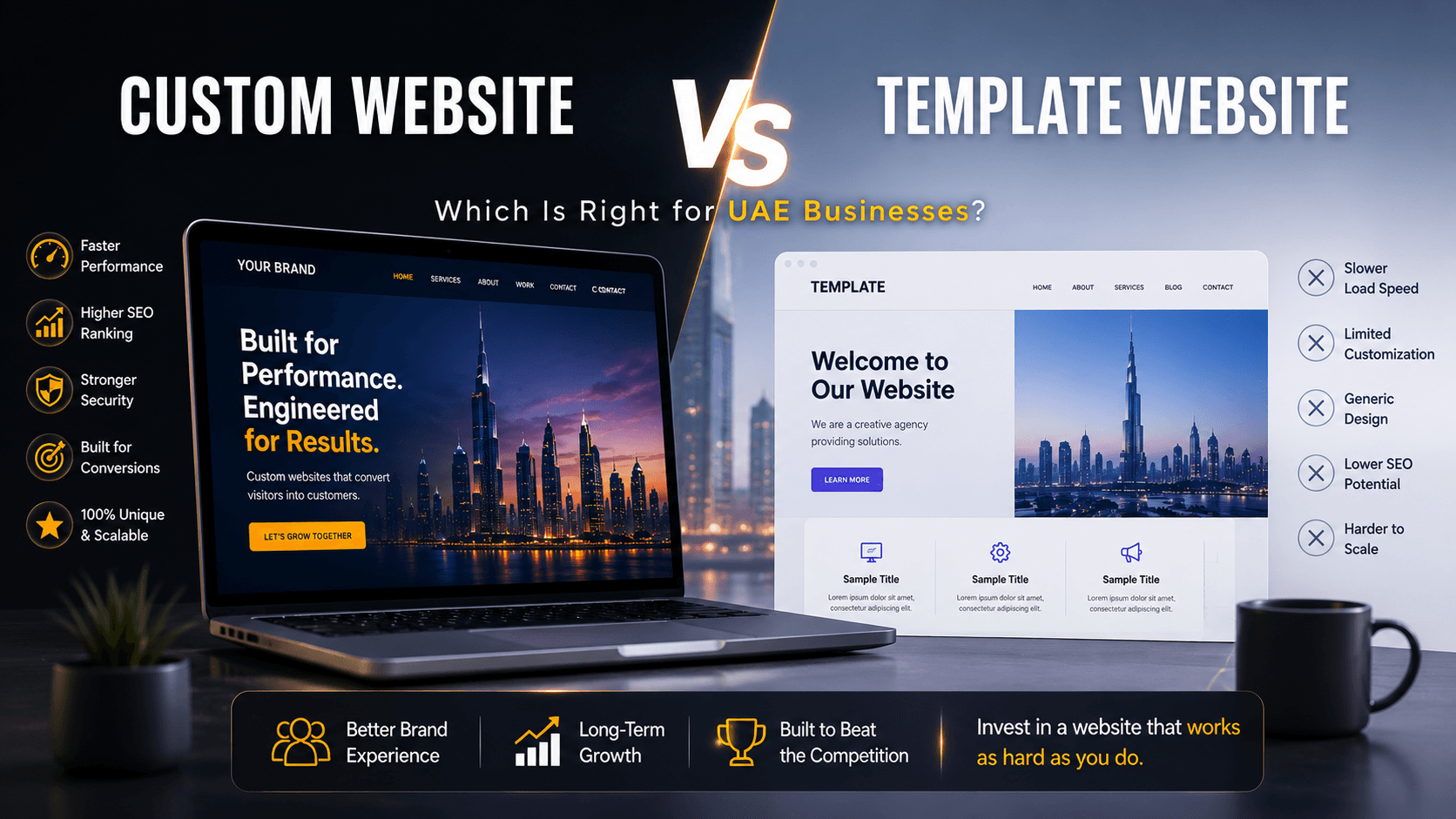
Templates look attractive because they're cheap and fast. You can be online in a day for AED 1,000. Custom development takes weeks and costs more. So why do serious UAE businesses the ones generating real leads from their website almost all end up on custom-built platforms?
Because a website isn't a brochure. It's a sales machine. And sales machines need to be engineered, not assembled from a catalogue.
What “template” and “custom” actually mean
Template website
Built using a pre-made theme (WordPress, Wix, Squarespace, Shopify free themes). The design, structure, and often the code are shared with thousands of other websites. You customise colours, fonts, and content but the underlying architecture is fixed.
Custom website
Built from scratch (or on a framework like Next.js) specifically for your business. Every page, feature, and conversion path is designed around your buyers and your goals. Nothing is shared with any other website.
Head-to-head comparison
When a template website makes sense
Templates aren't always wrong. There are specific situations where they're the right call:
But be honest about the costs you're accepting:
When custom development is worth every dirham
If your website is responsible for generating leads, booking calls, selling products, or representing your brand in a competitive market custom is not a luxury. It's the only option that will actually perform.
Here's the economics: a custom site at AED 20,000 that generates 10 qualified leads per month pays itself back in the first 60 days for most UAE service businesses. A template at AED 3,000 that generates zero leads is infinitely more expensive.
The real question isn't “can I afford custom?” it's “can I afford not to have a website that actually converts?”
Frequently asked questions
Is a template website good enough for a UAE business?
For very early-stage businesses, personal portfolios, or side projects with no commercial pressure, a template can get you online quickly and affordably sometimes for as little as AED 1,000. But for any UAE business that relies on its website for leads, bookings, or sales, a template's performance limitations, SEO ceiling, and generic appearance will cost far more in lost revenue than the savings on the build. A template site loading in 4–7 seconds instead of under 2 seconds measurably reduces conversions and hurts Google rankings through Core Web Vitals, and a design that looks identical to thousands of other businesses undermines the premium positioning many UAE brands are trying to build. In our experience, most businesses that launch on a template end up commissioning a custom rebuild within 2–3 years once the limitations become a genuine bottleneck to growth at which point they've effectively paid twice. If your website drives revenue, budget for custom from the start rather than treating the template as a permanent solution.
How much faster is a custom website vs a template in Dubai?
Custom websites built on modern frameworks like Next.js typically load in under 2 seconds, even on mobile connections common across the UAE. Template-based WordPress sites running page builders like Elementor or Divi average 4–7 seconds once you factor in plugin bloat, unoptimised images, and render-blocking scripts that ship with most themes by default. In the UAE, where Google's Core Web Vitals (LCP, INP, and CLS) directly affect search rankings, that 2–5 second gap translates directly into lost ranking positions especially for competitive commercial keywords where dozens of Dubai businesses are competing for the same terms. It also affects conversion directly: studies on mobile page speed consistently show bounce rates climbing sharply once load time passes 3 seconds, and UAE mobile data speeds vary significantly by network and location. A slow template site doesn't just rank worse it loses visitors before they ever see your offer, which is the more expensive problem of the two.
Can a template website rank on Google in the UAE?
Templates can rank for low-competition, long-tail search terms, but they hit a hard ceiling quickly. Slow load speeds, bloated theme code, and shared design and content patterns make it nearly impossible to compete on high-value commercial keywords against businesses running custom, performance-optimised sites. Google's ranking algorithm increasingly rewards page experience signals alongside content relevance, and a template site is structurally disadvantaged on both: the code is heavier, the Core Web Vitals scores are typically worse, and duplicate design patterns across thousands of similarly-themed sites make genuine differentiation harder to achieve through content alone. We regularly see UAE businesses spend heavily on SEO content for a template site while ignoring that the platform itself is capping their ranking potential no amount of content work fully compensates for a slow, generic technical foundation. If ranking for competitive commercial terms matters to your business, the technical foundation needs to support that goal from day one, not fight against it.
Related reading
Ready for a website that actually performs?
Get a free quote for a custom-built website engineered specifically for your UAE business no templates, no shortcuts.