Logistics & Supply Chain Website UAE: Digital Presence Guide (2026)
The UAE is a global logistics hub Dubai handles 15% of global air cargo and Jebel Ali Port is the world's 9th busiest. Yet most UAE logistics company websites are generic, outdated, and fail to communicate the specific capabilities that B2B buyers evaluate when selecting freight and supply chain partners. The website is often the first filter in a long RFQ process.
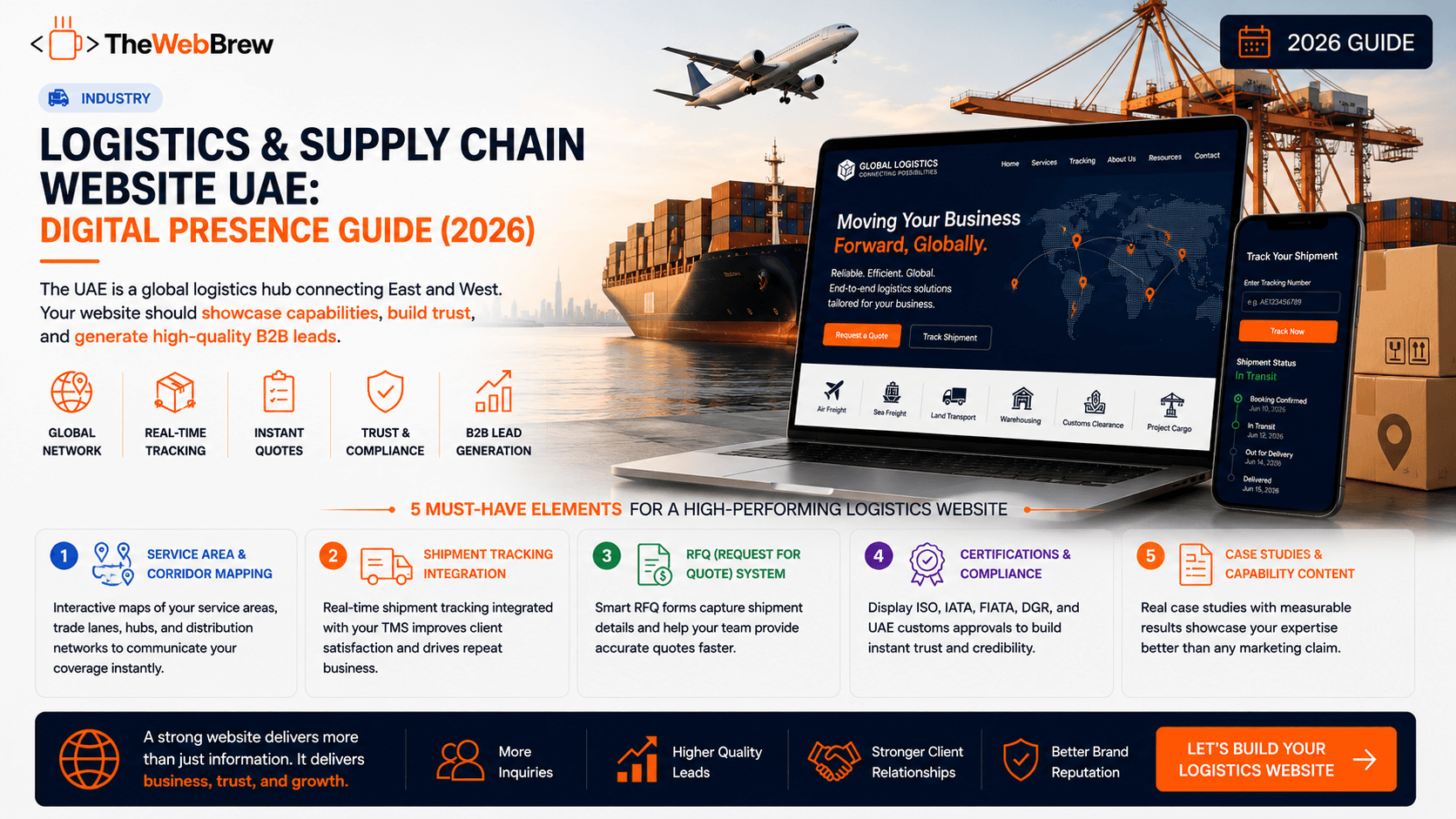
Service area and corridor mapping
UAE logistics companies operate specific trade corridors and service regions. An interactive map showing your service areas (GCC, MENA, South Asia, Africa), hub locations, and distribution networks communicates your coverage instantly to B2B buyers evaluating logistics partners. Service corridor maps consistently outperform text descriptions for conveying geographic capability.
Shipment tracking integration
If you operate your own TMS (Transportation Management System), exposing a tracking interface on your website where clients can enter a reference number and see shipment status is a significant client retention tool. Companies whose clients have daily reasons to visit their website build stronger relationships than those who communicate only via email.
RFQ (Request for Quote) system
B2B logistics buyers don't want to call. An RFQ form that captures: origin, destination, cargo type, weight/volume, timeline, and incoterms allows your operations team to provide an informed quote rather than a discovery call. RFQ systems that send an auto-acknowledgement and estimated response time significantly improve the buyer experience.
Certifications and industry compliance display
ISO certifications, IATA accreditation, FIATA membership, DGR certifications, and local UAE customs authority approvals are major trust signals for logistics clients. Display them prominently ideally with verification links or badge images. In a sector where compliance failures can cost clients shipments, proof of certification matters enormously.
Case study and capability content
'We moved 500 tonnes of pharmaceutical cargo from India to Dubai in 72 hours under cold chain conditions' is infinitely more compelling than 'we provide reliable pharmaceutical logistics'. Specific case studies with measurable outcomes build credibility with the operations managers and procurement teams who actually evaluate logistics vendors.
Frequently asked questions
Why do B2B logistics buyers care so much about a company's website before requesting a quote?
Because for most UAE logistics buyers, your website is the first filter in a long procurement process often before they ever speak to your sales team. Operations managers and procurement teams use the website to quickly assess whether you serve their trade corridors, hold the certifications their compliance department requires (ISO, IATA, FIATA, DGR), and have handled cargo similar to theirs before. A generic, outdated site with no specific service corridor information or certification display gets filtered out before an RFQ is ever submitted, regardless of your actual operational capability. Since Dubai handles 15% of global air cargo and competes with dozens of other UAE-based freight and logistics providers, the website's job is to survive that first filter: clear service area mapping, visible certifications, and specific case studies do more to generate qualified RFQs than any amount of generic marketing copy.
Is it worth building shipment tracking into our company website instead of just using our TMS directly?
Yes, if you already operate a TMS (Transportation Management System), exposing a simple tracking interface on your website where clients enter a reference number to see status is a high-value, relatively low-cost addition. It gives your clients a reason to visit your website regularly rather than communicating only through email or phone, which measurably strengthens the ongoing relationship and reduces status-check calls to your operations team. The integration itself is usually a matter of connecting your existing TMS API to a simple front-end tracking page rather than building new tracking infrastructure from scratch, so the cost is mostly in the website integration work, not the underlying system. Logistics companies that add this feature typically see it become one of the most-visited pages on their site, since active shipments generate repeat visits throughout their transit.
What should an RFQ form for a UAE logistics website actually capture to be useful?
A well-designed RFQ form should capture origin and destination, cargo type, weight or volume, required timeline, and Incoterms at minimum enough detail for your operations team to return an informed quote without needing a discovery call first. Forms that only ask for name, email, and a generic message force an extra round of back-and-forth before a real quote can be given, which slows down the buyer's evaluation process and increases the chance they move on to a competitor who responded faster. Pairing the form with an automatic acknowledgement email that states an estimated response time (for example, 'we typically respond within 4 business hours') significantly improves the buyer experience and reduces anxious follow-up emails. The goal is to make the RFQ process feel as professional and responsive as the logistics service itself.
Related reading
Build your UAE logistics website
TheWebBrew builds B2B websites for UAE logistics and freight companies RFQ systems, service mapping, tracking integration, and industry-specific SEO.
Get a Free Quote