Fintech Website Development UAE: Security, UX & Compliance (2026)
UAE fintech is one of the fastest-growing sectors in the region, with DIFC and ADGM attracting hundreds of financial startups and scale-ups. But fintech websites face a harder design challenge than most: they must convert sceptical users who are handling their money, comply with strict regulatory disclosure requirements, and project the security and trust that financial products demand all simultaneously.
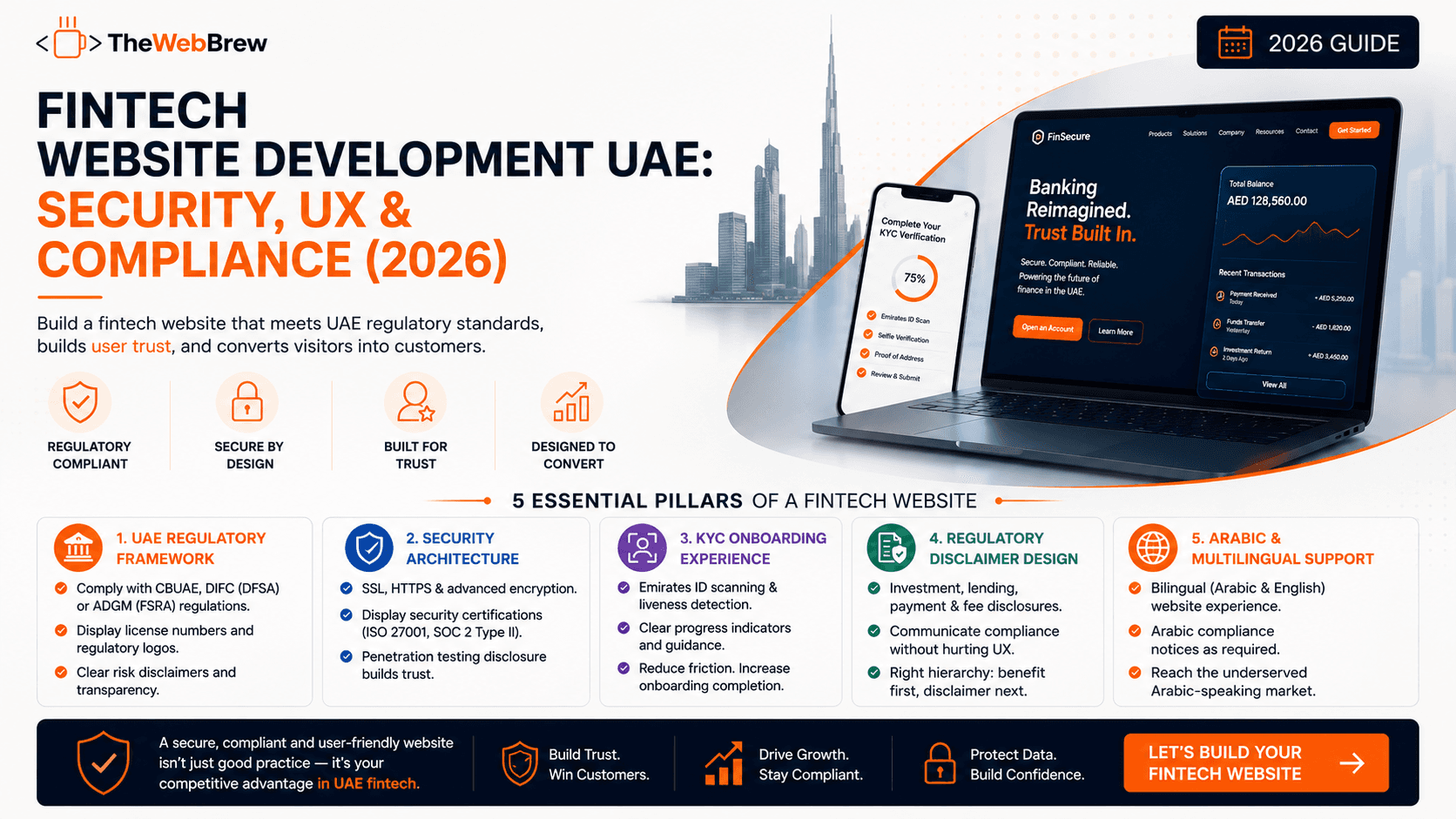
UAE regulatory framework for fintech websites
UAE fintech operates under multiple regulatory bodies depending on jurisdiction: CBUAE (Central Bank of UAE) for mainstream financial services, DIFC (Dubai International Financial Centre) under the DFSA, and ADGM (Abu Dhabi Global Market) under the FSRA. Each regulator has specific requirements for how financial services can be marketed online, what disclosures must be made, and how data is handled. Your website must reflect your regulatory status accurately including license numbers, regulatory logos, and mandatory risk disclaimers.
Security architecture that users can see
Fintech customers make trust decisions in seconds. Every security signal matters: SSL certificate with proper HTTPS (not just the padlock the certificate provider matters for sophisticated users), security certifications displayed (ISO 27001, SOC 2 Type II), penetration testing disclosure, data encryption statement. These signals on your homepage and registration page directly impact sign-up conversion. UAE users are particularly security-aware for financial products following high-profile regional fraud incidents.
KYC onboarding UX design
KYC (Know Your Customer) is mandatory for UAE fintech and is the primary conversion bottleneck for most platforms. Well-designed KYC flows in the UAE handle Emirates ID scanning (which most users prefer over manual entry), selfie-based liveness detection, and Arabic-language instructions for non-English speakers. Reducing the perceived complexity of KYC progress indicators, clear explanations of why each document is needed, immediate confirmation significantly increases onboarding completion rates.
Regulatory disclaimer architecture
Fintech websites must display risk disclaimers appropriate to their product category: investment platforms must state capital is at risk; lending platforms must display representative APR; payment services must disclose fee structures. The design challenge is communicating required compliance content without destroying the marketing message. The answer is hierarchy: lead with the benefit, follow with the disclaimer in appropriate prominence visible but not overwhelming.
Arabic and multilingual support
UAE fintech serves a market where Arabic is the official language and regulatory preference. CBUAE increasingly requires Arabic-language compliance notices. Beyond compliance, Arabic content reaches a massive underserved fintech market Arabic-speaking residents who are significantly underbanked relative to their English-speaking expat counterparts. A bilingual fintech website in the UAE is both a regulatory consideration and a market opportunity.
Frequently asked questions
What regulatory disclosures does a UAE fintech website legally need to display?
The specific disclosures depend on which UAE regulator governs your fintech, CBUAE for mainstream financial services, DFSA for DIFC-registered companies, or FSRA for ADGM-registered companies, and each has different requirements for how financial services can be marketed online. In general, your website needs to display your licence number and regulator logo accurately, clear risk disclaimers appropriate to your product category such as capital-at-risk statements for investment platforms or representative APR for lending platforms, and transparent fee structure disclosures for payment services. The design challenge is balancing required compliance content against marketing effectiveness: the standard solution is a content hierarchy that leads with the customer benefit and follows immediately with the disclaimer in appropriate but not overwhelming prominence. Getting this wrong isn't just a design issue, inaccurate or missing regulatory information on a UAE fintech website can trigger real regulatory scrutiny, so legal review of every disclosure is essential before launch.
How can a UAE fintech website reduce KYC onboarding drop-off?
KYC is the primary conversion bottleneck for nearly every UAE fintech platform, so the highest-impact fixes focus directly on reducing perceived friction rather than the underlying requirement itself. Support Emirates ID scanning as the default input method, since most UAE users strongly prefer it over manual data entry, and use selfie-based liveness detection rather than document-only verification where your compliance framework allows it. Show clear progress indicators throughout the flow so users always know how many steps remain, and provide a short explanation of why each specific document or piece of information is being requested, since unexplained requests are a common abandonment point. Offer Arabic-language instructions throughout the flow, not just on the landing page, for the significant portion of UAE users who prefer to complete sensitive processes in Arabic. Each of these changes is a UX decision, not a compliance change, meaning it can be implemented without altering your actual regulatory KYC requirements.
Does a UAE fintech website need to be bilingual in Arabic and English?
Yes, effectively. Arabic is the UAE's official language and increasingly a regulatory expectation, CBUAE is progressively requiring Arabic-language compliance notices for financial products, so bilingual support is becoming close to mandatory rather than a nice-to-have. Beyond compliance, Arabic content opens access to a substantial and underserved fintech market: Arabic-speaking UAE residents are significantly underbanked relative to their English-speaking expat counterparts, representing genuine growth opportunity rather than just a legal checkbox. A properly bilingual fintech website needs more than translated marketing copy; the KYC flow, risk disclaimers, transaction confirmations, and support content all need accurate Arabic versions reviewed by a native speaker, since a mistranslated compliance disclosure carries real regulatory and trust risk. For a UAE fintech company weighing where to invest limited development budget, a genuinely bilingual website is one of the few investments that simultaneously improves regulatory positioning and expands the addressable market.
Related reading
Build your UAE fintech website
TheWebBrew builds fintech websites for UAE-regulated companies CBUAE/DIFC compliant, security-first, Arabic bilingual, and built to convert in a trust-sensitive environment.
Discuss Your Fintech Website