WooCommerce vs Magento vs Custom: Which for UAE Businesses?
Beyond Shopify, three serious e-commerce options exist for UAE businesses: WooCommerce (WordPress-native), Magento/Adobe Commerce (enterprise-grade), and fully custom-built platforms. Each serves a different business profile. Here's how to know which is right for you.
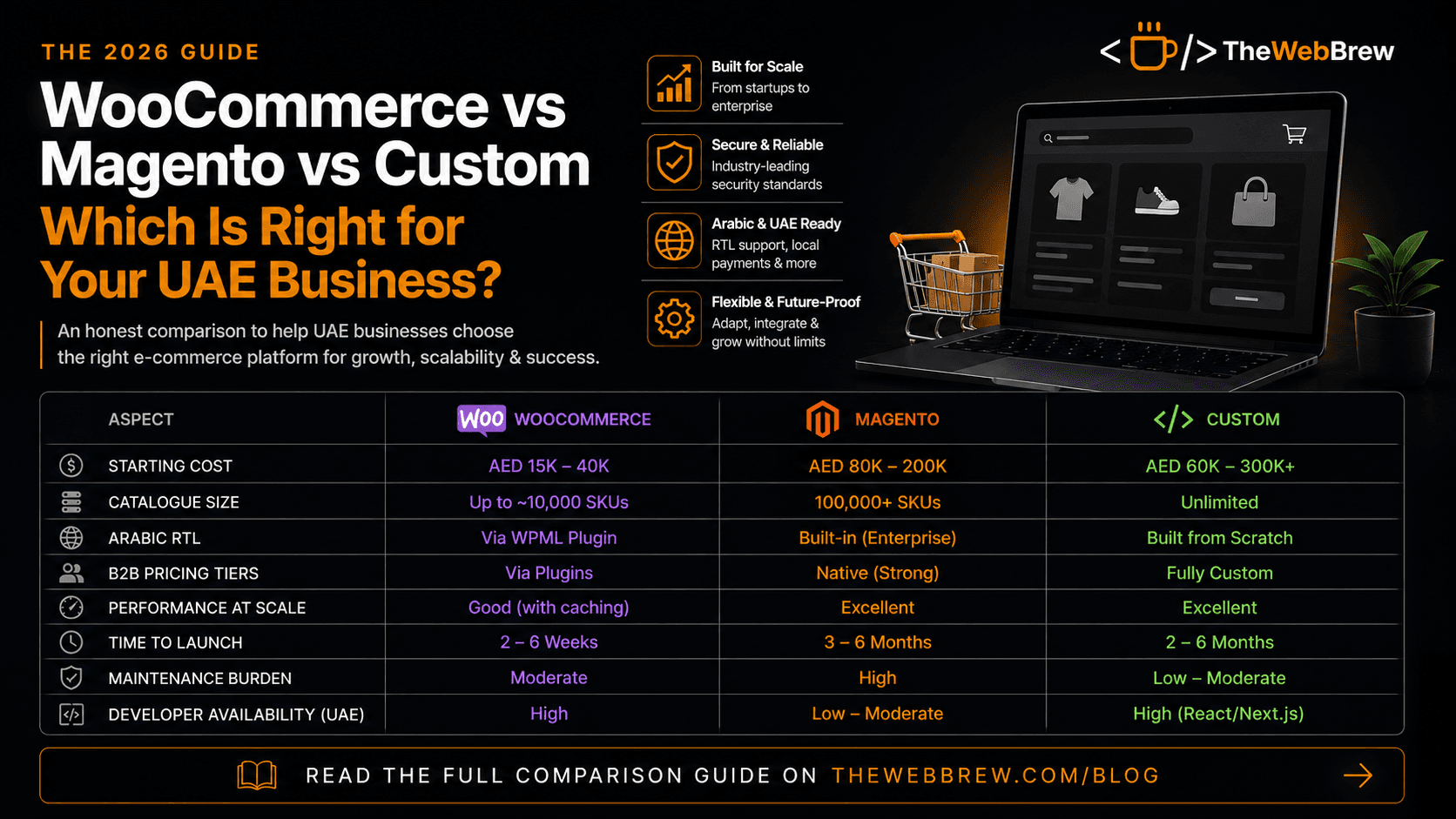
Most UAE e-commerce comparisons focus on Shopify vs WooCommerce. But for businesses with large catalogues, complex B2B requirements, or the need for a completely proprietary platform, the real decision sits between WooCommerce, Magento, and a bespoke custom build.
Platform overview
WooCommerce
A WordPress plugin that turns your CMS into a full e-commerce store. The most widely deployed e-commerce platform globally. Free to install; costs come from hosting, premium plugins, and development. Works best for businesses already on WordPress, catalogues under ~10,000 SKUs, and teams that want SEO control alongside their store.
Magento / Adobe Commerce
Enterprise-grade e-commerce used by large retailers and B2B distributors. Handles massive catalogues (100,000+ SKUs), complex B2B pricing tiers, multi-warehouse inventory, and multi-store setups natively. The Open Source edition is free; Adobe Commerce (formerly Magento Enterprise) costs tens of thousands per year in licensing. Requires specialist Magento developers which are scarcer in the UAE than WordPress or React developers.
Custom-Built Platform
A bespoke e-commerce application built from scratch typically on Next.js (frontend) with a custom backend or headless commerce layer. No platform limitations, no licensing fees, no technical debt inherited from a legacy CMS. You own the entire codebase. Best for businesses with genuinely unique requirements that no off-the-shelf platform can accommodate, or brands where the shopping experience is a core competitive differentiator.
Side-by-side comparison
| Factor | WooCommerce | Magento | Custom |
|---|---|---|---|
| Starting cost | AED 15,000–40,000 | AED 80,000–200,000 | AED 60,000–300,000+ |
| Monthly hosting | AED 150–500 | AED 800–3,000 | AED 300–2,000 |
| Catalogue size | Up to ~10,000 SKUs | 100,000+ SKUs | Unlimited |
| Arabic RTL | Via WPML plugin | Built-in (Enterprise) | Built from scratch |
| B2B pricing tiers | Via plugins | Native (strong) | Fully custom |
| Developer availability UAE | High | Low-moderate | High (React/Next.js) |
| Maintenance burden | Moderate | High | Low-moderate |
| Performance at scale | Good (with caching) | Excellent | Excellent |
| Time to launch | 2–6 weeks | 3–6 months | 2–6 months |
How to decide for your UAE business
Choose WooCommerce if…
- You're already on WordPress
- Catalogue is under 10,000 SKUs
- Budget is AED 15,000–40,000
- SEO and content marketing are your primary channels
- You don't have complex B2B pricing logic
Choose Magento if…
- You have 50,000+ product SKUs
- You have complex B2B pricing tiers or customer-specific catalogues
- You need multi-warehouse inventory across UAE and GCC
- You have existing Magento infrastructure to migrate to
Choose Custom if…
- Your business logic can't fit any existing platform
- The shopping experience is a core brand differentiator
- You want zero long-term platform fees
- You're building a marketplace or multi-vendor platform
- You need deep ERP/POS integration from day one
Frequently asked questions
My UAE store has outgrown WooCommerce is Magento or custom the right next step?
It depends on why you've outgrown it. If the issue is purely catalogue size or B2B pricing complexity (tiered customer pricing, multi-warehouse inventory across UAE and GCC), Magento's native features solve this directly and are worth the higher AED 80,000-200,000 investment and specialist developer cost. If the issue is that WooCommerce feels limiting for your specific business logic a unique checkout flow, marketplace functionality, deep ERP integration a custom build gives you unlimited flexibility without inheriting Magento's licensing costs or steep learning curve. If your real bottleneck is site speed or SEO rather than catalogue size, a performance audit and hosting upgrade often solves it for a fraction of a platform migration's cost, so rule that out first before committing to a rebuild.
Is Magento worth it for a mid-sized UAE business, or is that overkill?
For most mid-sized UAE businesses, Magento is overkill. Its real strength is B2B complexity multiple pricing tiers, customer-specific catalogues, multi-warehouse inventory, and 50,000+ SKUs which the majority of mid-sized retailers don't need. Magento also carries a higher total cost of ownership: specialist Magento developers are scarcer and more expensive in the UAE market than WordPress or React developers, and the Adobe Commerce licence alone runs tens of thousands annually at enterprise scale. Unless you specifically need native B2B pricing logic or are already managing 50,000+ products, WooCommerce (for content-driven stores) or a custom Next.js build (for a differentiated shopping experience) will deliver better ROI with lower ongoing maintenance burden and a wider local developer talent pool to draw from.
How much does migrating from WooCommerce to a custom platform cost in the UAE?
A full migration from WooCommerce to a custom-built platform in the UAE typically costs AED 60,000-300,000+, depending on catalogue size, integrations, and design complexity, with a realistic timeline of 2-6 months. The bulk of the cost isn't rebuilding the storefront it's migrating product data, order history, customer accounts, and any third-party integrations (payment gateways, ERP, marketing tools) without data loss or downtime. Budget extra time for parallel testing running both platforms briefly before full cutover to catch discrepancies in inventory sync or checkout behaviour. Most UAE businesses that migrate do so because they've hit a genuine ceiling on customisation or performance, not because of an arbitrary preference, so confirm the specific limitation first to make sure a custom build actually resolves it.
Related reading
Not sure which platform fits your business?
We'll assess your catalogue, budget, and requirements and recommend the right platform with a fixed-price quote.
Get a Free Assessment