Midjourney + Figma: How AI is Transforming UI/UX Design (2026)
The best Dubai design agencies aren't replacing designers with AI they're turning one designer into the output of three by combining Midjourney's image generation with Figma AI's production capabilities. This is the actual workflow, the real time savings, and what it means for UAE businesses commissioning design work in 2026.
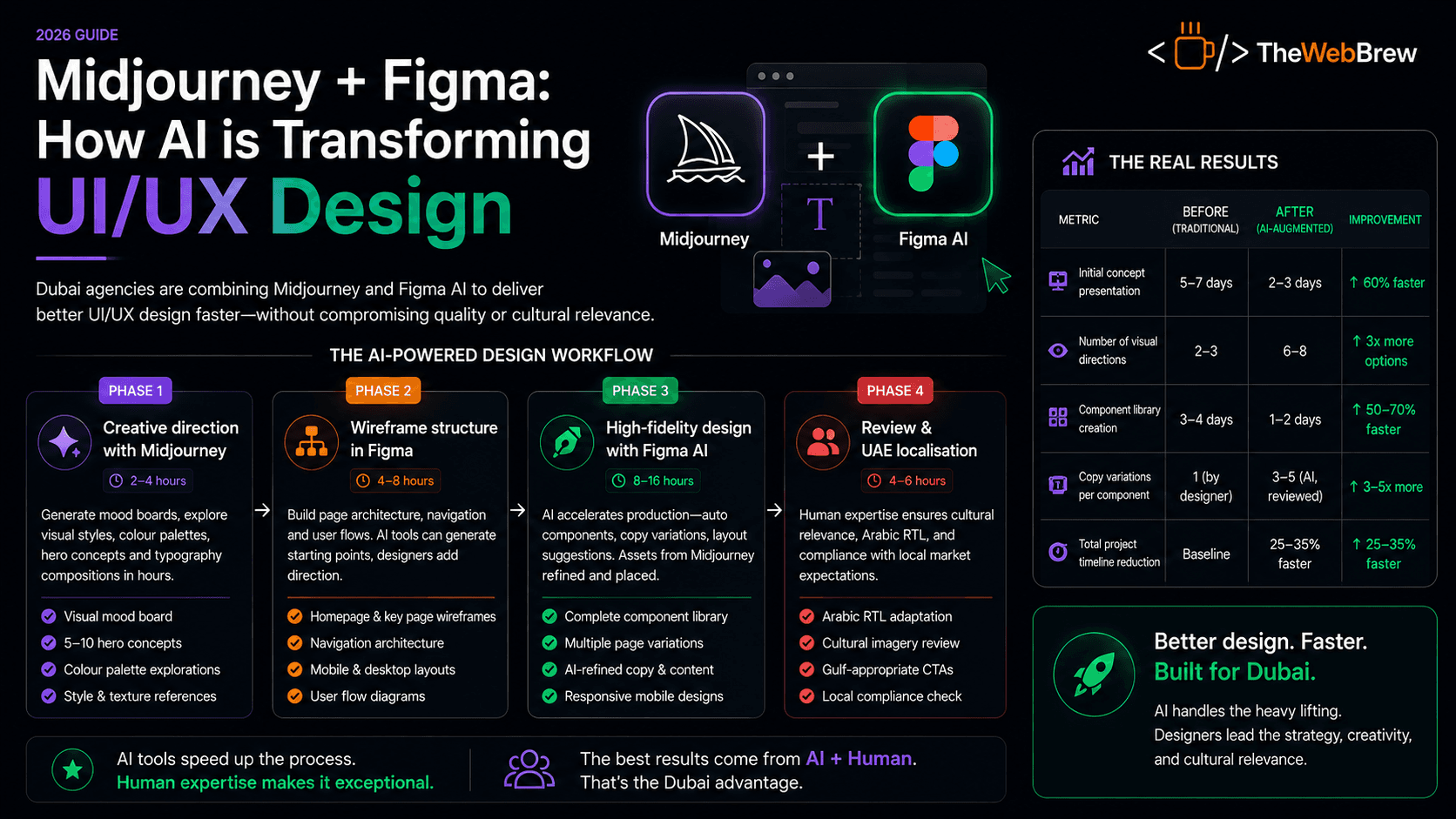
The AI-augmented design workflow
Creative direction with Midjourney
Before opening Figma, the designer uses Midjourney to explore visual directions. Abstract mood boards, colour palette explorations, hero image concepts, and typographic compositions are generated and curated rapidly. What used to take a full day of manual moodboarding takes 2–4 hours. The output isn't production-ready assets it's creative direction and client-alignment material.
Wireframe structure in Figma
Low-fidelity wireframes are still done by the designer in Figma AI layout generators like Framer AI or Figma's own Wireframe plugin can produce starting points in minutes, but they need significant human direction to reflect the specific UX intent. The designer creates the page architecture, navigation structure, and key interaction flows.
High-fidelity design with Figma AI
Figma AI accelerates the production phase significantly. Auto-naming of components, generating copy variations for text layers, creating multiple card variants from a single component, and intelligent component suggestions all reduce time on production work. Midjourney-generated images are refined in Adobe Firefly for background removal and extension, then placed into Figma layouts.
Review and UAE localisation
This phase is entirely human it's where UAE-specific knowledge is applied. Arabic RTL version, cultural review of imagery, checking that CTA language resonates with Gulf consumers, and ensuring nothing in the AI-generated content violates local sensitivities. No AI tool can do this it requires human expertise in the UAE market.
Before and after: the impact on timelines
| Design deliverable | Traditional | AI-augmented |
|---|---|---|
| Initial concept presentation | 5–7 days | 2–3 days |
| Number of visual directions presented | 2–3 | 6–8 |
| Component library creation | 3–4 days | 1–2 days |
| Copy variations per component | 1 (by designer) | 3–5 (AI, reviewed by human) |
| Total project timeline reduction | Baseline | 25–35% faster |
What AI still can't do in UAE web design
The workflow above produces excellent results because of what AI is specifically not responsible for. AI generates visual options; human designers make creative judgments. AI produces imagery; UAE designers apply cultural context. AI accelerates production; experienced designers direct what gets produced.
Two things remain firmly in human territory: the strategic brief (what this design needs to achieve for this specific UAE business, their customers, and their positioning) and the cultural layer (what works visually for Gulf Arabic consumers, conservative sector sensitivities, Arabic RTL conventions). These are the parts of design that justify professional fees in 2026.
For UAE businesses, the practical implication is that an AI-augmented agency should deliver more more options, faster iterations, better-refined output at a similar or lower cost to a traditional workflow. The question to ask when briefing any UAE agency is: 'Show me how AI tools feature in your design process.'
Frequently asked questions
Do AI design tools like Midjourney and Figma AI mean I no longer need a professional design agency in Dubai?
No AI tools accelerate production, they don't replace professional judgement. Midjourney generates visual directions and Figma AI speeds up component work, but a UAE design agency still owns the parts that decide whether a project succeeds: brand positioning, conversion-focused UX structure, and Gulf-specific cultural review of imagery, colour, and CTA language. Anyone can prompt Midjourney for pretty visuals, but knowing which of six directions actually fits your business goals and which would misfire with a conservative Gulf audience requires real design experience. What changes with AI is speed and volume: agencies using this workflow present more options, build component libraries faster, and iterate quicker at similar or lower cost than a traditional process. If an agency tells you 'AI does the design', treat that as a warning sign. The strongest UAE studios use AI purely as a production accelerant while strategy, UX decisions, and cultural judgement stay firmly with experienced human designers.
How much does an AI-augmented design project cost compared to a traditional design process in the UAE?
AI-augmented design typically costs the same or slightly less than a traditional UAE design project, while delivering noticeably more for the money. Because Midjourney and Figma AI cut mood boarding and production time by roughly a third, agencies can present more visual directions, build fuller component libraries, and turn around revisions faster without charging a premium for the extra output. A typical Dubai business website design phase that once took 5-7 days for the first concept now takes 2-3 days, and instead of two or three visual directions you'll usually see six to eight. The savings come from compressed production hours, not from cutting corners on strategy or cultural review those phases still need the same senior human time they always did. If a UAE agency quotes well below market rate and cites 'AI' as the reason, ask exactly which phases AI speeds up versus which stay fully human-led before signing anything.
Can Midjourney and Figma AI properly handle Arabic RTL layouts and Gulf-specific cultural design requirements?
Not on their own. Midjourney and Figma AI have no inherent understanding of Arabic right-to-left reading patterns, Gulf cultural sensitivities, or which imagery resonates with UAE audiences versus what could cause offence generating that judgement is entirely a human responsibility. What the tools do well is production: once a UAE designer has determined correct RTL mirroring, appropriate imagery direction, and culturally suitable colour and iconography choices, Figma AI can speed up building the Arabic version of components and Midjourney can generate region-appropriate visual assets faster than manual sourcing. But the review phase covering RTL layout correctness, cultural appropriateness of imagery, and whether CTA language resonates with Gulf consumers must be done by an experienced UAE-based designer, every time, on every project. Any agency skipping this human review step to save time is taking a real risk with your brand in a market where cultural missteps get noticed and shared quickly online.
Related reading
AI-augmented design for your UAE project
TheWebBrew uses Midjourney, Figma AI, and Adobe Firefly throughout our design process delivering more options, faster, with UAE-specialist direction on every project.
Start Your Design Project