Hotel & Hospitality Website Design UAE: What Works in 2026
UAE hotels paying 15–25% OTA commissions on every booking have a leaking revenue model. A well-built hospitality website with direct booking capability, multilingual content, and proper visual storytelling can shift a significant portion of bookings direct recovering commission margin that funds the website cost many times over.
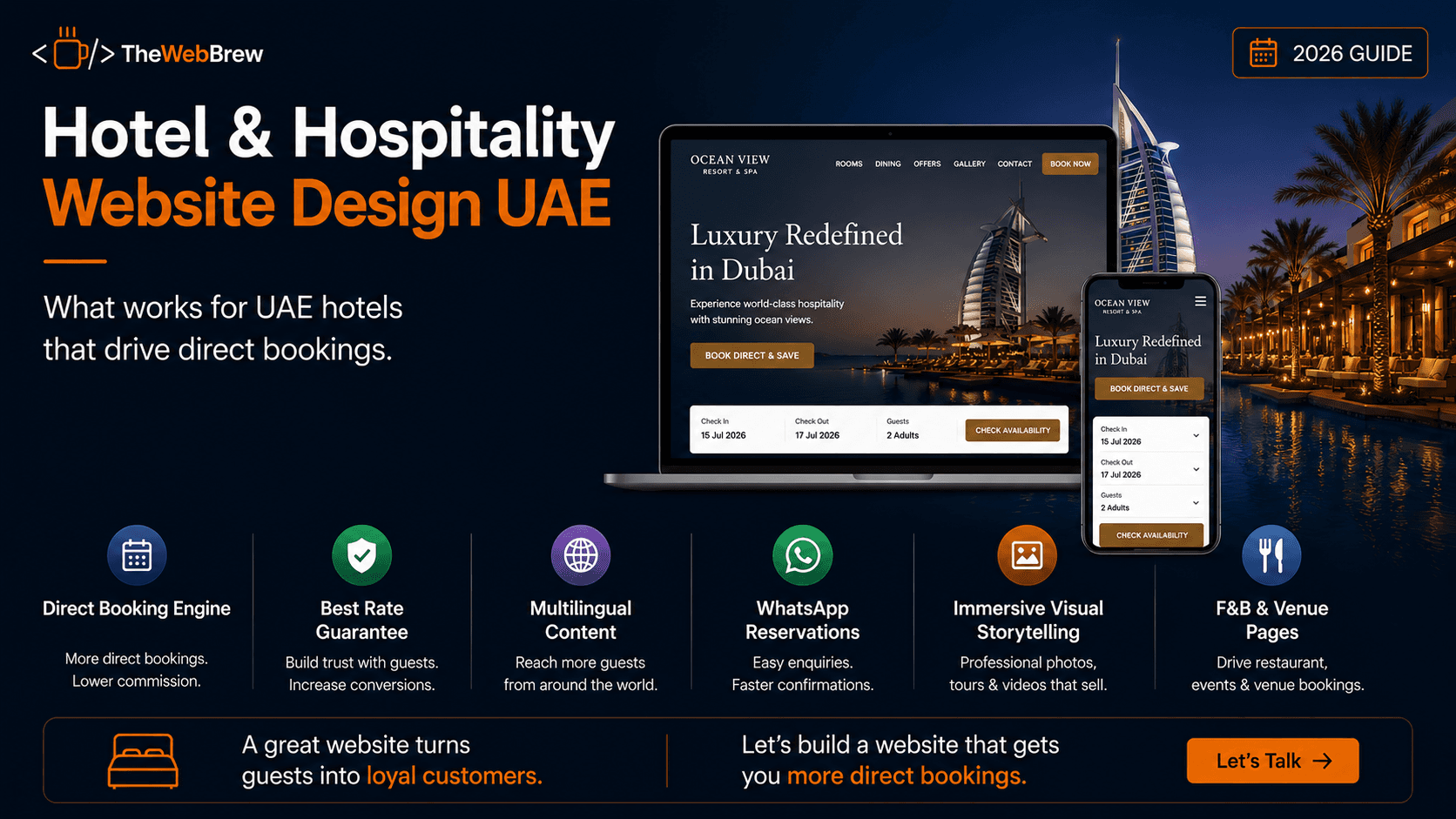
What high-performing UAE hospitality websites do differently
Direct booking engine
Every booking made via Booking.com or Expedia costs 15–25% commission. A direct booking engine (Siteminder, Clock PMS, or custom) on your own website recovers that margin. The ROI on a well-designed booking engine pays for the website within months for most UAE properties.
Best rate guarantee widget
A persistent 'Book Direct Best Rate Guaranteed' widget gives guests the confidence to bypass OTAs. Pair it with a direct booking benefit (free upgrade, late checkout, complimentary transfer) to push conversion higher.
Multilingual content
UAE hospitality guests come from 190+ nationalities. Arabic and English are essential; Russian, Chinese (Mandarin), and German serve key source markets. Full multilingual content not just translated menus significantly increases booking conversion from each market.
WhatsApp reservations
UAE guests expect WhatsApp. A prominent WhatsApp button connected to your reservations team for availability checks, special requests, and group bookings converts browsers who aren't ready to commit to the online booking flow.
Immersive visual storytelling
Hotel websites sell an experience before the guest arrives. Professional photography, short video clips of the pool and restaurant, drone footage of the location, and 360° room tours all directly impact booking conversion. Cutting the photography budget is the fastest way to underperform vs. competitors.
F&B and venue pages
UAE hotels generate significant revenue from F&B, events, and venue hire. Dedicated pages with online table reservations (via SevenRooms or a custom form), menus with photos, and event space enquiry forms capture revenue beyond room bookings.
The UAE hospitality market difference
Dubai Tourism targets 25 million visitors annually by 2027. The competition among UAE properties from luxury resorts to boutique hotels is intense, and the website is often the first brand touchpoint. UAE guests (particularly GCC travellers and high-net-worth visitors) expect premium digital experiences that match the property's in-person quality.
Ramadan and holiday periods bring unique considerations. UAE hotel websites need to handle seasonal promotions (Iftar packages, National Day deals) cleanly, with clear Arabic messaging for local guests. Generic Western hotel website templates often fail on this dimension entirely.
Frequently asked questions
How much revenue do UAE hotels lose to OTA commissions like Booking.com and Expedia?
Most UAE hotels and resorts pay between 15% and 25% commission on every booking made through Booking.com, Expedia, or Agoda, and this comes straight off the top line before any operating costs are covered. For a mid-size UAE property doing AED 2 million in annual room revenue through OTAs, that is AED 300,000 to AED 500,000 handed to a third party every year purely for the booking transaction. A well-built hotel website with a proper direct booking engine, a best-rate guarantee widget, and clear calls to action can realistically shift 20–30% of that OTA volume to direct bookings within the first year. The website investment itself (typically AED 15,000–40,000 for a hospitality-grade build with booking engine integration) is usually recovered from commission savings within a few months, making it one of the highest-ROI investments a UAE hotel can make in 2026.
Do UAE hotel websites really need more than Arabic and English?
Yes if your property attracts international guests, which almost every UAE hotel does. Dubai and Abu Dhabi hospitality guests arrive from more than 190 nationalities, and beyond Arabic and English, the highest-value source markets are Russian, Chinese (Mandarin), German, and increasingly Indian travellers booking through UAE-facing OTAs. Full multilingual content means translating room descriptions, amenities, F&B menus, and the booking flow itself, not just running the homepage through a translation plugin. Guests who cannot read the cancellation policy or room details in their own language are far more likely to abandon the booking and go straight to an OTA where translated reviews are already available. For a boutique UAE property, prioritising Arabic, English, and Russian first typically covers the majority of the addressable direct-booking audience, and additional languages can be added as guest data shows demand from specific source markets.
Is WhatsApp booking worth adding to a hotel website in the UAE?
Almost always, yes. UAE guests across every demographic default to WhatsApp for quick questions, and a hotel website without a visible WhatsApp option loses guests who are close to booking but have one unanswered question (group size, early check-in, connecting rooms, dietary requirements) that they don't want to resolve through a contact form and a 24-hour email wait. A prominent WhatsApp button connected to a live reservations team lets your staff handle availability checks, special requests, and multi-room group bookings in real time, which converts hesitant browsers that a pure online booking engine would lose. It works well alongside a direct booking engine rather than replacing it: guests who want a self-service flow use the booking widget, while guests who want reassurance before paying use WhatsApp. UAE hotels that add WhatsApp reservations typically report a meaningful lift in direct enquiries within the first month, particularly for group and corporate bookings.
Related reading
Build a direct-booking hospitality website
TheWebBrew builds hotel and hospitality websites for UAE properties multilingual, booking-engine integrated, and built to shift revenue direct.
Discuss Your Hotel Website